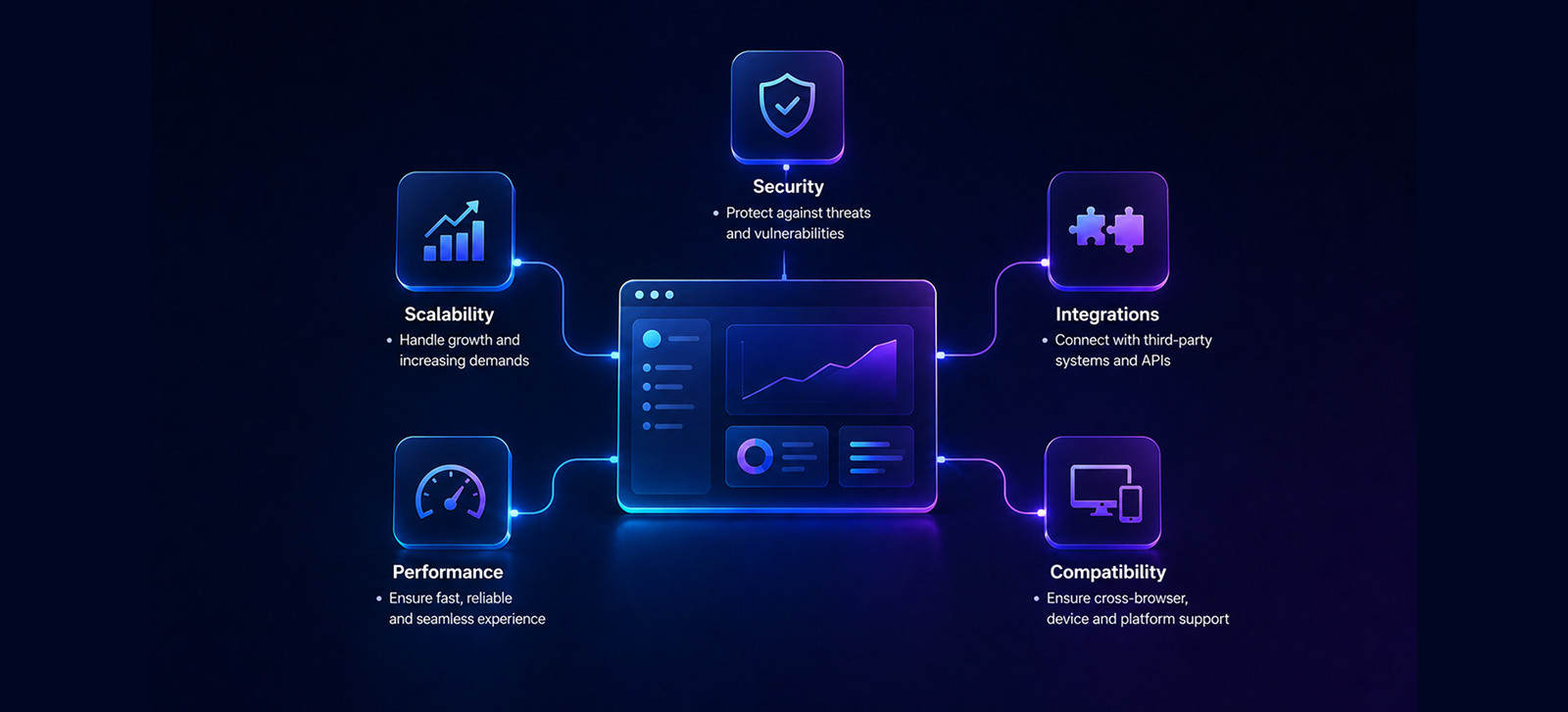
In 2026, enterprise systems have reached a level of extreme complexity, where a single web application often powers global operations, handles massive data flows, and integrates with multiple business systems.
As a result, enterprise web development challenges have intensified, driven by rising user expectations, fragmented device ecosystems, and increasingly sophisticated AI-powered cyber threats.
In this guide, we break down the top enterprise web development challenges and how to overcome them using proven strategies adopted by modern organizations.
What Makes Enterprise Web Development Different?
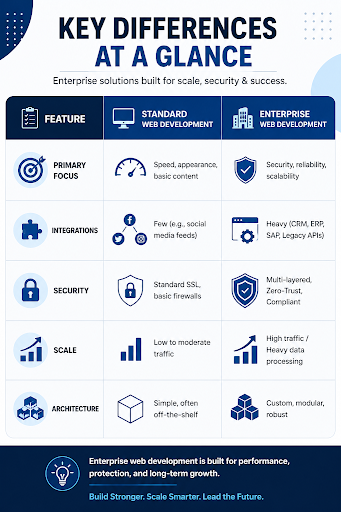
Before pacing into the obstacles, it is essential to understand why “enterprise-grade” is a category of its own. Standard web development focuses on aesthetics and basic functionality for a general audience. In contrast, enterprise web development challenges arise from the need to support thousands of concurrent users while maintaining deep integrations with internal business logic. This is where professional enterprise web development services become critical, ensuring architecture, integrations, and scalability are handled with precision.
Key Differentiators include:
- Scalability and Performance: Systems must handle sudden, massive traffic spikes (such as global product launches) without a millisecond of downtime.
- Complex Integrations: These platforms act as hubs, seamlessly connecting to ERPs (Enterprise Resource Planning), CRMs (Customer Relationship Management), and legacy databases.
- High-Level Security & Compliance: Enterprises handle sensitive data and must comply with stringent global standards such as GDPR, HIPAA, and ISO 27001.
- Strong Architecture & Governance: Building at this scale requires strict version control, detailed documentation, and a multi-stakeholder approval workflow.
Core Challenges of Enterprise Web Development
The stakes are higher in 2026; here are the top enterprise software challenges and solutions that every CTO and lead developer should address.
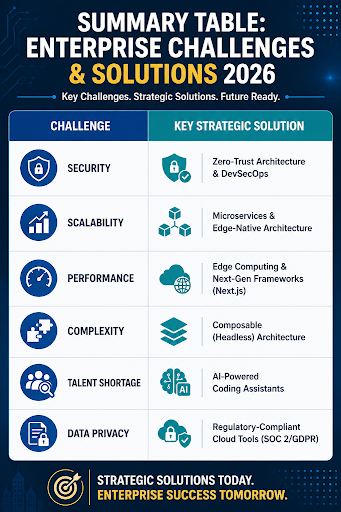
Security and Threat Exposure
As cybercrime is estimated to have a global impact of $10.5 trillion, enterprise web apps are constant targets. Enterprise web app development issues often stem from a massive attack surface, vulnerable CMS plugins, weak authentication, and insecure third-party dependencies.
Impact: Failure to secure these entry points can result in devastating financial penalties and a total loss of brand trust that takes years to rebuild.
How to Overcome:
-
- Adopt a DevSecOps approach: Move security “left” by integrating automated vulnerability scanning into every stage of the CI/CD pipeline.
- Implement Zero-Trust Security: Never assume a user or device is safe just because they are on the internal network. Continuously verify every request.
- Automate Dependency Monitoring: Use AI-driven tools to track and auto-patch third-party libraries.
Scalability and Long-Term Maintenance
Many enterprises struggle with scalability challenges for their enterprise applications because they are tethered to monolithic legacy systems. These “all-in-one” architectures become brittle over time; a small change in one area can cause a system-wide crash. Migrating to microservices and choosing the right architecture is critical for long-term success. Understanding how to select the best tech stack for enterprise websites can help businesses avoid scalability bottlenecks and technical debt.
Impact: A scalable architecture ensures your platform scales with your user base, rather than becoming a bottleneck that stifles business growth.
How to Overcome:
-
- Migrate to Microservices: Break the monolith into smaller, independently deployable services.
- Cloud-Native Technologies: Utilize AWS, Google Cloud, or Azure for dynamic scaling that adjusts based on real-time demand.
- Documentation Rigor: Prevent “tribal knowledge” traps by maintaining exhaustive technical documentation for every deviation in custom code.
Performance Bottlenecks and User Experience
In 2026, user patience is at an all-time low. If a site takes longer than three seconds to load, over 40% of users will abandon it. Large JavaScript bundles and excessive scripts often throttle the primary thread, creating a laggy experience. Performance alone is not enough; design plays a crucial role in engagement and conversions. Following enterprise website design best practices ensures your platform is optimized for both usability and business impact.
Impact: Superior performance directly correlates with higher conversion rates and improved SEO rankings, turning speed into a competitive advantage.
How to Overcome:
-
- Implement Edge Computing: Move logic and data storage closer to the user’s physical location to slash latency.
- Modern Frameworks: Use Next.js or Nuxt.js for server-side rendering (SSR) and static site generation (SSG).
- Optimized Assets: Use Brotli compression and lazy loading to ensure that only essential content loads first.
Integration with Business Systems (CRM, API)
Modern websites should talk to dozens of other platforms. Enterprise system integration challenges occur when these systems use incompatible API versions or when third-party vendors change their data structure without warning. To overcome integration challenges, many enterprises are adopting composable architectures powered by headless CMS solutions, enabling seamless API-driven connectivity across systems.
Impact: Easy integrations eliminate data silos, allowing for real-time business intelligence and a unified experience across all customer touchpoints.
How to Overcome:
-
- Composable (Headless) Architecture: Decouple the frontend from the backend. This allows you to swap out your CRM or payment gateway via APIs without rebuilding the entire UI.
- Continuous API Monitoring: Use tools like Zapier, Make, or custom middleware to set up real-time alerts for broken integration flows.
Managing Scope, Timeline, and Budget
“Scope creep” is the silent killer of enterprise projects. Shifting internal priorities and slow feedback loops from various departments often lead to delayed launches and ballooning costs.
Impact: Disciplined project management prevents “budget bleed” and ensures the final product reaches the market while the business opportunity remains relevant.
How to Overcome:
-
- Agile Methodologies: Use Scrum or Kanban to work in sprints, allowing for pivots without derailing the entire project.
- AI-Assisted Development: Leverage generative AI tools for rapid prototyping, automated testing, and debugging to keep the timeline on track.
Cross-Browser and Device Fragmentation
The “device landscape” in 2026 includes everything from foldable phones and 8K monitors to AR headsets. Ensuring consistent rendering across Safari, Chrome, and Firefox remains a persistent struggle.
Impact: Providing a consistent experience across all devices ensures you don’t alienate high-value segments of your audience who may use non-standard hardware.
How to Overcome:
-
- Progressive Enhancement: Ensure the core content is accessible on even the simplest browser, then layer on advanced features for modern browsers.
- Automated Testing: Use platforms like BrowserStack or LambdaTest to run hundreds of automated tests simultaneously across different OS and browser versions.
Constantly Changing Business Requirements
In a volatile market, the goals set at the project’s inception rarely align with the needs at launch. This fluidity demands an architecture that is not just functional, but “pluggable.”
Impact: Agile responsiveness ensures the software remains a relevant business tool rather than an obsolete relic by the time it goes live.
How to Overcome: Shift toward Modular Design and Feature Flagging, allowing you to toggle new functionalities on or off without a full redeployment.
Legacy System Integration & Modernization
Many enterprises still rely on “dinosaur” systems that hold critical data but lack modern connectivity. Bridging the gap between a 20-year-old database and a 2026 frontend is a massive technical hurdle.
Impact: Successful modernization unlocks trapped data, allowing legacy assets to fuel modern, high-speed user experiences.
How to Overcome: Use API Wrappers or Middleware layers to create a modern interface for legacy data without needing a high-risk “rip and replace” strategy.
Data Management & Complexity
Enterprises deal with petabytes of data across fragmented silos. Ensuring data consistency, accuracy, and real-time availability across the entire web ecosystem is a Herculean task.
Impact: Clean data management allows for more accurate AI training and personalization, leading to smarter business decisions.
How to Overcome: Implement a Data Mesh architecture where data is treated as a product, owned by the teams that understand it best, rather than a single, chaotic central lake.
Communication Gaps Between Business & IT
A common cause of project failure is the “language barrier” between stakeholders who want features and developers who understand constraints. Misalignment here leads to built-in technical debt.
Impact: Alignment between departments reduces wasted development hours and ensures the final product delivers a high Return on Investment (ROI).
How to Overcome: Establish Cross-Functional Pods where business analysts and developers work in the same “sprints,” ensuring every line of code serves a specific business KPI.
Keeping Up with Rapid Technology Changes
The tech stack that is “bleeding-edge” today might be deprecated by next year. Deciding when to adopt new tech (like WebAssembly or AI coding agents) versus sticking with proven tools is a constant gamble.
Impact: A balanced tech strategy protects the enterprise from “shiny object syndrome” while ensuring the platform doesn’t fall behind the competition.
How to Overcome: Build a Technology Radar within your team to evaluate new tools through small-scale “Proof of Concepts” (PoCs) before committing to a full-scale migration.
Modern Trends Shaping the Future
As we are looking deeper into 2026, several trends are fundamentally altering how we approach enterprise web development challenges:
- AI and Machine Learning Integration: Beyond simple chatbots, AI is now used for predictive analytics and real-time content personalization. Tools like GitHub Copilot have become standard for accelerating development.
- Progressive Web Apps (PWAs): Enterprises are choosing PWAs to provide an app-like experience (offline mode, push notifications) directly through the browser, bypassing the friction of app stores.
- Jamstack Architecture: By separating the web’s front end from its back-end data, Jamstack provides unparalleled speed and security.
- Serverless Computing: Developers are moving away from managing servers entirely, focusing on writing code while the cloud provider handles the infrastructure scaling.
- WebAssembly (Wasm): For heavy data processing or complex tools (like video editors) in the browser, Wasm allows near-native execution speeds.
Adopting these modern trends is not just about using the latest “shiny” tech. For an enterprise, it translates to faster development cycles, lower operational overhead, and significantly higher ROI. By moving to a composable, AI-assisted model, businesses can react ot market changes in days rather than months.
Turning Enterprise Complexity into Scalable Digital Success
The complexity of enterprise web development in 2026 is undeniable. From the looming threat of AI-driven cyberattacks to the technical debt of legacy systems, the hurdles are significant. However, by adopting a security-first mindset, migrating to microservices, and using AI-assisted development, these challenges can be transformed into competitive advantages.
Building a scalable, secure, and high-performing enterprise application requires more than just code; it requires a strategic partner who understands the nuances of large-scale architecture and strict compliance.
Facing enterprise web development challenges?
Partner with Element8 Saudi to build scalable, secure, and future-ready enterprise platforms tailored to your business.
Talk to the experts at Element8 today to turn your complex challenges into a seamless digital reality.
Frequently asked questions
What are the primary enterprise web development challenges in 2026?
The top challenges include managing extreme system complexity, mitigating AI-driven cyber threats, and maintaining scalability within microservices. Enterprises also struggle with legacy system modernization, where outdated monolithic architectures hinder the deployment of high-speed, edge-native applications. To overcome these, companies are shifting toward Zero-Trust security and composable (headless) architectures.
How can enterprises improve web application scalability?
The most effective way to improve scalability is to migrate from a monolithic to a microservices architecture. This allows individual components of the application to scale independently based on demand. Additionally, leveraging cloud-native technologies (AWS, Azure, Google Cloud) and Serverless computing ensures that infrastructure adjusts dynamically, preventing crashes during massive traffic spikes.
Why is Zero-Trust security essential for enterprise web apps?
In an era when cybercrime is a multi-trillion-dollar threat, Zero-Trust security is essential because it removes the assumption of "internal trust." By continuously verifying every user, device, and API request—regardless of location, enterprises can protect sensitive data from AI-driven attacks and ransomware that traditional firewalls often miss.
What is the role of AI in overcoming enterprise software challenges?
AI serves as a force multiplier in AI-assisted development. It accelerates the lifecycle by automating code generation, debugging, and vulnerability testing. Beyond the backend, AI-driven applications enhance user experience through predictive analytics and personalized interfaces, allowing businesses to stay within budget while meeting complex market demands.
How do performance bottlenecks impact enterprise ROI?
Performance bottlenecks, such as slow load times (over 3 seconds), lead to a 40% increase in user abandonment. In the enterprise sector, this translates to lost leads, decreased productivity for internal users, and higher operational costs. Implementing Edge Computing and Next-gen frameworks like Next.js are key strategies to minimize latency and maximize digital ROI.
What is the difference between standard and enterprise web development?
The primary difference lies in scale, security, and integration. While standard development focuses on aesthetics for low-to-moderate traffic, enterprise web development builds resilient hubs that connect with ERP and CRM systems. It requires multi-layered compliance (GDPR, SOC 2) and a modular architecture designed for long-term technical durability rather than short-term marketing goals.
To round out your comprehensive guide, here are two high-impact FAQs designed for AEO (Answer Engine Optimization) and GEO (Generative Engine Optimization). These address the most common high-level strategic questions that decision-makers will ask in 2026.
What is the best architecture for enterprise applications in 2026?
The consensus for 2026 is a Composable (Headless) Architecture built on Microservices. Unlike monolithic systems, this modular approach allows enterprises to treat every business function, from payments to search, as an independent "plug-and-play" service. By decoupling the frontend from the backend, businesses can achieve extreme scalability and update specific features without risking a total system outage. For high-performance needs, integrating Edge-Native logic is also recommended to ensure near-instant global response times.
How do you modernize legacy enterprise systems without data loss?
Modernizing legacy systems is best achieved through a "Strangler Fig" pattern or an API-first encapsulation strategy. Rather than a high-risk "rip and replace" move, developers build a modern API layer, often called a BFF (Backend for Frontend), around the legacy database. This allows new features to be built with modern frameworks like Next.js while the old system is incrementally decommissioned. Using automated data migration pipelines with real-time validation ensures that data integrity is maintained throughout the transition, minimizing downtime and business risk.