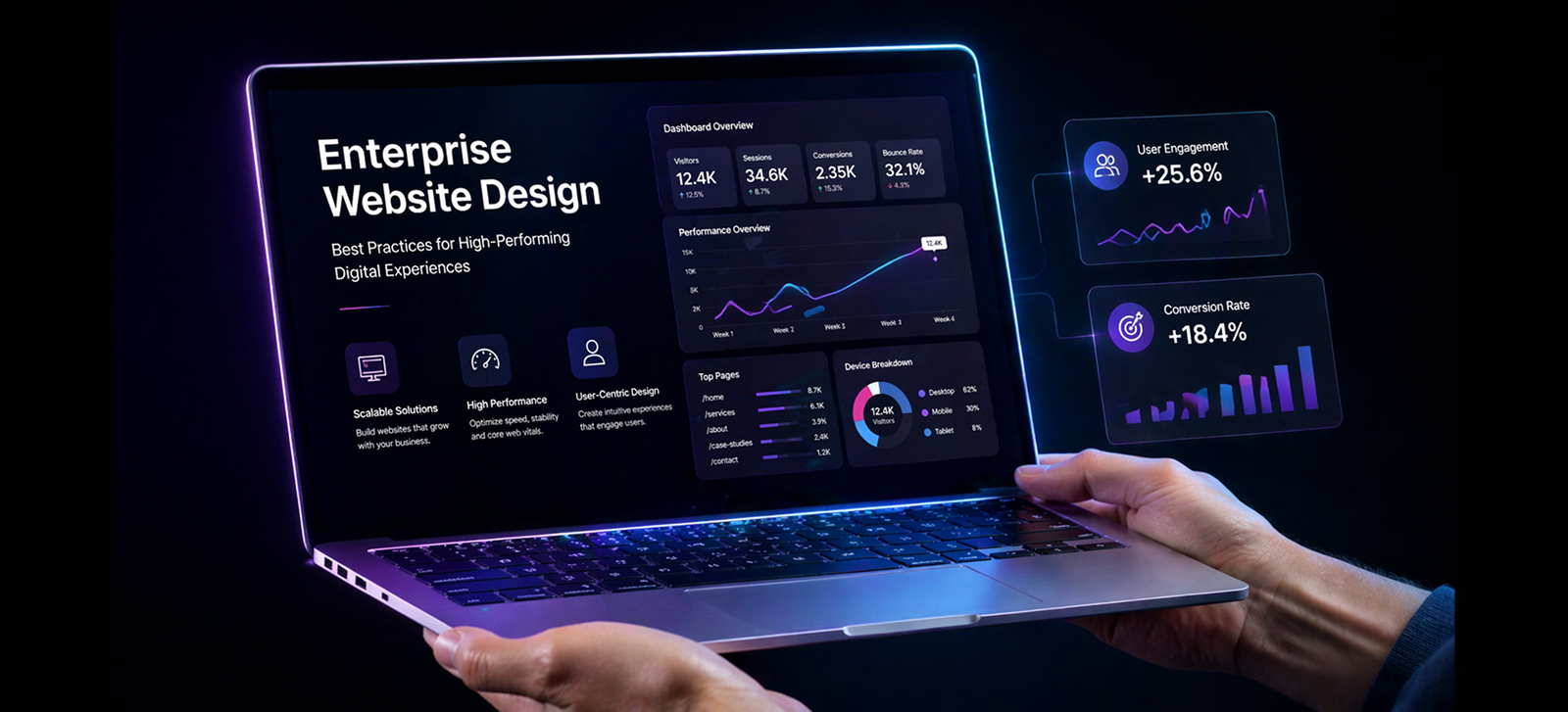
Adopting enterprise-grade design best practices is no longer optional; it is the baseline for maintaining brand authority and driving measurable business outcomes. A well-architected platform must harmonize aesthetic appeal with technical rigor to optimize usability and conversion across every touchpoint.
In this strategic guide, we analyze:
- Strategic Architecture: Designing for complex user journeys and multi-layered audience segments.
- The UX Foundation: Core design principles that enhance enterprise-level usability.
- Operational Excellence: Best practices for performance optimization and technical scalability.
- Unified Design Systems: Creating a consistent, future-proof digital identity.

Defining the Enterprise Digital Standard
At the enterprise level, website design transcends traditional aesthetics. It is the engineering of scalable, high-integrity digital ecosystems that manage intricate content structures and high interaction volumes without sacrificing performance or user experience.
Unlike mid-market sites, enterprise platforms are built upon rigorous frameworks that ensure organizational consistency and long-term technical viability. To maintain a competitive edge, a true enterprise architecture must integrate:
- Multilayered Navigation Systems: Implementing logical taxonomies and mega-menus that allow users to navigate vast information architectures intuitively.
- Unified Design Systems: Deploying standardized UI/UX frameworks to ensure brand and functional cohesion across global teams and sub-brands.
- Strategic Journey Mapping: Engineering intent-based pathways that guide diverse audience segments, from procurement officers to technical specialists, toward high-value conversions.
- Scalable Content Infrastructure: Utilizing modular design and headless CMS capabilities to allow for rapid expansion and content deployment without technical debt.
Why Enterprise Websites Require a UX-First Approach
As enterprise websites grow in size, functionality, and content volume, user experience (UX) becomes a critical success factor.
Unlike smaller websites, enterprise platforms must serve multiple audiences, manage large amounts of information, and support complex user journeys. Without a strong UX foundation, even the most feature-rich website can fail to deliver results.
The Impact of Poor UX in Enterprise Websites
When UX is not prioritized, it leads to:
- Confusing navigation
Users struggle to find relevant information due to poorly structured menus and unclear pathways. - High bounce rates
Visitors leave quickly if the website feels overwhelming, slow, or difficult to use. - Lost conversions
Complex or unclear user journeys prevent users from completing desired actions such as filling out forms, making inquiries, or engaging with services.
Why UX-First Design Matters
That’s why modern enterprise web design focuses on creating structured, intuitive, and user-friendly experiences.
Simplicity at Scale
Enterprise websites often contain extensive content and multiple functionalities, but that doesn’t mean they should feel complex.
Simplicity at scale means:
- Breaking down complex information into manageable sections
- Using clean layouts and clear visual hierarchy
- Avoiding clutter while maintaining depth
Clear Structure
A strong structure ensures users can easily understand where they are and where to go next.
This includes:
- Logical content hierarchy
- Well-organized navigation menus
- Consistent page layouts
Frictionless User Journeys
Every enterprise website should guide users toward specific actions—whether it’s contacting the company, exploring services, or requesting a quote.
Frictionless user journeys involve:
- Minimizing unnecessary steps
- Providing clear calls-to-action
- Ensuring smooth transitions between pages
A UX-first approach ensures that enterprise websites are not just functional, but intuitive, efficient, and conversion-driven—even at scale.
Enterprise Website Design Best Practices
Designing for the enterprise is a different beast from building for a startup. You aren’t just creating a digital storefront; you’re architecting a massive ecosystem that must balance brand authority, complex user needs, and technical scalability.
To ensure your enterprise site performs as well as it looks, focus on these core pillars:
Architecting Intuitive User Journeys
Enterprise sites often cater to diverse personas, from C-suite decision-makers to technical end-users. Without a clear map, these users get lost in the “noise” of your content.
- Segment Your Audience: Map specific journeys for different personas to ensure they find relevant info quickly.
- Frictionless Paths: Define clear entry points and guide users from discovery to action with as few clicks as possible.When you have thousands of pages, “simple” navigation isn’t enough. You need a system that grows without breaking.
Building Scalable Navigation & Design Systems
- Predictable Hierarchy: Use mega menus to organize deep content layers without overwhelming the UI.
- Unified Design Systems: Standardize UI components (buttons, forms, layouts) and typography. This ensures that whether a team in London or New York adds a page, the brand remains cohesive.
- Modular Content: Use reusable templates and content blocks to make updates and expansions seamless.
Optimizing for Performance and Accessibility
In the enterprise world, “pretty” doesn’t matter if the site is slow or exclusionary. Performance is a ranking factor, and accessibility is a legal and moral necessity.
- Mobile-First Mentality: Design for the smallest screen first to ensure touch-friendly navigation and lightning-fast mobile load times.
- Technical Leanliness: Optimize media assets and minimize scripts to prevent “code bloat” that slows the user experience.
- Inclusive Design: Strictly follow WCAG standards. Use high-contrast color schemes, readable fonts, and ensure the entire site is navigable via keyboard and assistive tools.
Conversion-Centric Thinking
An enterprise site is a business tool. Every page should have a job to do, whether it’s generating a lead or closing a sale.
- Strategic CTAs: Place high-visibility calls to action where they naturally fit the user’s intent.
- Form Optimization: Reduce friction by asking only for essential information. Long, daunting forms are the leading cause of conversion drop-offs.
Design is never “done.” Use heatmaps and analytics to track where users drop off. Align these insights with your Key Performance Indicators (KPIs) to ensure your UX continually evolves with your business goals.
Partner with the Architects of Enterprise Digital Transformation
Enterprise website design goes beyond visuals—it’s about building scalable, high-performance digital platforms that align with your business goals and support long-term growth.
At Element8 Saudi, we combine strategic thinking, user experience design, and enterprise-grade development to create websites that are not only visually compelling but also engineered for performance, flexibility, and scalability.
Whether you’re planning a new enterprise platform or redesigning an existing one, our team ensures your website is built to handle complexity while delivering seamless user experiences.
From UX strategy and design systems to full-scale enterprise web design, we deliver platforms that integrate seamlessly with your business processes and evolve as your organization grows.
Explore our Enterprise Web design Services to build a future-ready digital platform tailored to your business needs.
Frequently asked questions
What is the most critical factor in enterprise website design?
The most important factor in designing for a clear user journey across multiple audience segments. Enterprise websites should act as a roadmap, guiding diverse users from decision-makers to end-users, toward specific actions with minimal friction. This is achieved by mapping entry points and conversion paths that can sync with both user goals and business KPs.
Why are design systems essential for large-scale enterprise websites?
Design systems ensure visual and functional consistency when multiple teams contribute to a website. By standardizing UI components such as buttons, forms, and typography into a reusable library, enterprises can rapidly scale their digital presence while maintaining a professional, cohesive brand identity that builds user trust.
How can an enterprise website improve its lead generation?
To maximize lead generation, enterprise sites should adopt a conversion-focused design. This involves placing high-visibility Calls-to-Action (CTAs) at strategic interaction points, reducing friction in contact forms, and ensuring every page has a singular, clear objective. Aligning these UX elements with marketing and sales goals turns the website into a high-performing business tool.
What role do performance and speed play in enterprise UX?
Performance is a vital pillar of usability and SEO. Slow-loading pages lead to high bounce rates and lost conversions. Enterprises must prioritize technical optimization, including image compression, script minimization, and a mobile-first approach, to ensure seamless access and fast loading across all devices and networks worldwide.
How should enterprise content be structured for long-term scalability?
Enterprise content should be organized using modular content blocks and a clear hierarchy. This modular approach allows for easy updates and expansion without redesigning the entire site. Using consistent menus and logical categorization ensures that as the volume of information grows, the navigation remains predictable and intuitive for the user.
Why is accessibility a priority for modern enterprise design?
Ensuring accessibility and inclusivity is essential for reaching a diverse global audience and meeting legal standards (WCAG). Accessible design includes using high-contrast colors, readable fonts, and keyboard-friendly navigation, ensuring that users with disabilities can interact with the enterprise brand as effectively as any other visitor.