


Enterprise AI Integration for MENA Websites: How to Connect LLMs, Automation, and CRM Workflows Safely

There is a vast chasm between experimenting with artificial intelligence and integrating it into a core enterprise ecosystem. Dropping a generic chat widget onto the homepage or giving employees access to a public ChatGPT account does not create an enterprise AI system. In fact, doing so without strict guardrails can introduce severe compliance, operational, and security risks.
For large-scale organizations in the Middle East and North Africa (MENA) region, true digital transformation requires building a cohesive ecosystem in which the corporate website, Large Language Models (LLMs), Customer Relationship Management (CRM) tools, internal databases, and human workflows function as a single, unified engine. A strong foundation begins with a secure, scalable enterprise web development platform that can support AI integrations, automation, and complex business workflows from the outset.
To achieve this securely, enterprises should move away from direct ad hoc scripts and instead implement a governed middleware layer. This can act as a protective shield between public web interactions, AI reasoning engines, and internal system records such as HubSpot or Salesforce, ensuring that localized data automation remains safe, compliant, and highly accurate.
What Is Enterprise AI Integration?
At its core, Enterprise AI integration is the structured practice of embedding intelligent reasoning models deeply into a company’s architecture. Instead of operating in a silo, the AI is securely connected via Application Programming Interfaces (APIs) and orchestration engines to the systems that run the business.
- Front-End Touchpoints: Corporate websites, mobile apps, or secure customer portals.
- Systems of Record: CRM platforms (HubSpot, Salesforce, Microsoft Dynamics) and ERP systems (SAP, Oracle).
- Knowledge & Assets: Product databases, internal wikis, marketing automation engines, and document repositories.
- Operational Workflows: Internal approval systems, booking platforms, and real-time analytics dashboards.
This is fundamentally different from using public AI tools. Public tools are unmanaged, lack context regarding your proprietary business rules, and threaten data privacy because inputs can be used to train public models. True enterprise integration treats the LLM as a highly capable yet strictly sandboxed processing unit that acts only on authorized data via verified, secure pathways.
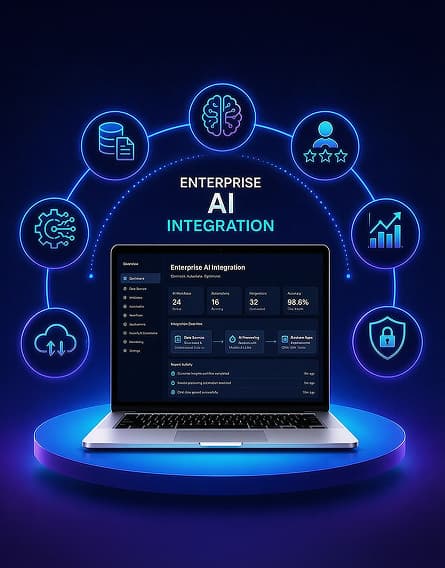
Why Integration Matters More Than AI Alone
Many organizations begin their AI journey by experimenting with standalone tools, but real business value comes from integration rather than isolated automation. An AI assistant that cannot access customer records, product information, booking systems, or internal knowledge can answer only general questions. By securely connecting AI with enterprise applications, businesses enable the system to perform meaningful tasks such as qualifying leads, retrieving account information, scheduling appointments, generating reports, and supporting employees with accurate, context-aware responses. This level of integration is only possible when the underlying enterprise web development architecture is designed to support scalable APIs, automation, security, and future AI capabilities.
Why MENA Businesses Are Integrating AI Into Their Websites
Organizations across Saudi Arabia, the UAE, Qatar, and the wider MENA region are now facing unique market dynamics. With rapid economic diversification, aggressive national digitalization mandates like Saudi Vision 2030, and an increasingly tech-savvy population, static websites are no longer competitive. Local enterprises are integrating AI for highly concrete commercial and operational advantages:
Faster Customer Responses
Modern consumers are expecting immediate gratification. AI-integrated websites eliminate lag times by answering complex, multi-step customer inquiries instantly, 24/7.365, without waiting for an agent to clear a ticketing queue.
Better Lead Qualification
Instead of forcing prospects to fill out exhaustive, friction-heavy forms, an intelligent interface can converse naturally. It can extract vital budgetary information, timelines, and intent data contextually, filtering out low-value inquiries before they ever reach human teams.
Reduced Manual Administration
By linking the website’s conversational layer directly to backend workflows, administrative overhead drops dramatically. The AI can auto-populate CRM fields, schedule meetings, verify order status, or update inventory without a human needing to copy and paste data across tabs.
Personalized Digital Experiences
When a logged-in B2B client or consumer visits the website, the AI reads their historical CRM profile. It customizes the interface, suggests relevant cross-sells based on past purchases, and addresses them with an understanding of their ongoing support tickets.
Improved Access to Enterprise Knowledge
Large organizations sit on mountains of unstructured data, PDF manuals, policy guidelines, and contract templates. An integrated AI system unlocks this data, making it instantly retrievable for both web visitors and internal staff through natural-language queries.
Native Arabic and English Customer Support
The MENA market demands flawless bilingual capabilities. Integrated enterprise systems handle both English and complex Arabic dialects seamlessly, adapting tone and cultural context perfectly to match regional expectations.
How LLMs Can Be Integrated Into an Enterprise Website
Deploying an LLM on an enterprise level requires selecting the right architecture for your data privacy tolerance and operational needs. There are four primary integration patterns:
-
Public Model API Integration
This approach connects your systems directly to enterprise-tier APIs provided by frontier model developers (such as OpenAI’s GPT-4o or Anthropic’s Claude 3.5 Sonnet). While the models themselves are hosted externally, enterprise contracts ensure your data is encrypted, kept private, and explicitly excluded from future model training.
-
Private or Enterprise-Managed Models
For highly regulated industries such as banking, healthcare, and government entities in the GCC, public APIs may be non-viable due to strict data residency laws. These organizations deploy open-weight models (such as Meta’s Llama 3 or regional models like Falcon) within their own private clouds (e.g., AWS Middle East, Microsoft Azure UAE, or local sovereign cloud providers). Data never leaves the enterprise boundary.
-
Retrieval-Augmented Generation (RAG)
LLMs are not databases; they are reasoning engines. To ensure the AI answers questions about your business with factual accuracy, enterprises use Retrieval-Augmented Generation (RAG). When a user asks a question, a specialized search is performed against an approved, internal vector database (the knowledge layer). The relevant documents are pulled, and only that verified text is handed to the LLM to formulate a response. This virtually eliminates hallucinations.
-
Tool and Function Calling
Instead of just generating text, modern LLMs can act. Through tool calling, an LLM can analyze a user’s prompt, recognize that it needs external data, and produce a structured instruction (such as a JSON payload). The middleware layer reads this instruction, calls the appropriate enterprise API (e.g., checking an ERP for product stock), and passes the live data back to the LLM to present to the user.
Connecting Website AI With CRM Workflows
The real magic happens when front-end web conversations trigger automated backend actions within your CRM.
Key integration points include:
- Lead capture and qualification: The AI serves as an interactive filter, guiding conversations to cleanly extract high-fidelity qualification data.
- Automated lead enrichment: By passing the user’s domain name to enrichment APIs through the workflow layer, the system instantly populates the CRM with company size, industry, and revenue metrics.
- Lead scoring and routing: Leads are instantly weighted based on conversational signals and routed geographically or vertically within HubSpot or Salesforce without delay.
- Sales follow-up automation: The system sets up reminders, builds contextual call sheets for reps, and customizes initial pitch documents based on what the user asked the website bot.
- Customer service workflows: Simple support tasks are completely offloaded. The AI verifies identity, looks up purchases in the CRM, consults troubleshooting manuals, and either marks the ticket as resolved or smoothly escalates it to a human with a full summary.
Example Enterprise AI Workflow
An effective enterprise AI integration does not simply answer customer questions. It orchestrates an end-to-end business process. Instead of relying on disconnected systems or manual follow-ups, AI can guide prospects through the sales journey while synchronizing every interaction with your CRM and business applications.
This workflow reduces manual administration while ensuring that every qualified inquiry is consistently captured, routed, and acted upon. Sales teams receive richer customer context, support teams spend less time collecting information, and prospects experience a faster, more personalized buying journey.
From Automation to Business Value
Once AI is securely integrated with enterprise systems, it becomes far more than a conversational assistant. It can automate repetitive business processes, improve customer engagement, accelerate decision-making, and provide employees with instant access to trusted business information. The following use cases demonstrate how organizations across the MENA region are using enterprise AI to improve operational efficiency and deliver better digital experiences.
High-Value Enterprise AI Use Cases for MENA Websites
How does this look in practice? Here are ten real-world scenarios where integrated AI transforms operations:
- AI customer service assistant: Resolves tier-1 support requests instantly by checking real-time order status, tracking shipments across GCC corridors, and answering technical product questions using RAG.
- Intelligent lead qualification: Converses naturally with web traffic to screen out unqualified visitors, booking high-intent B2B buyers directly onto sales calendars.
- Product or service recommendation: Acts as a digital personal shopper on e-commerce or B2B portals, analyzing customer history from the CRM to recommend perfectly matched parts or upgrades.
- AI-powered website search: Replaces rigid, keyword-based search bars with semantic search, enabling users to find obscure technical documentation by meaning rather than exact phrasing.
- Appointment and booking automation: Connects directly to localized scheduling tools, letting clients book, reschedule, or cancel consultations natively within a chat interface while synchronizing internal calendars.
- Request-for-proposal assistant: Accelerates long B2B sales cycles by allowing prospective clients to query compliance, capability, and pricing parameters instantly from a secure portal.
- Customer account assistant: Provides logged-in corporate clients with a dashboard where they can ask questions such as how much credit remains this month or request a summary of outstanding invoices, while data is pulled safely from the ERP.
- Internal knowledge assistant: Gives regional teams secure, natural-language access to localized HR policies, procurement rules, and legal templates.
- Multilingual content assistance: Automatically translates and culturally adapts customer inquiries and responses in real time, matching formal Modern Standard Arabic or local Khaleeji and Levantine phrasing.
- Marketing and customer journey automation: Tracks specific conversation topics to drop the contact into hyper-targeted email nurturing workflows within HubSpot or Salesforce Marketing Cloud.
Enterprise AI Across Key MENA Industries
The value of AI integration varies across industries, but the underlying objective remains the same: streamline operations while improving customer experiences.
- Healthcare providers can use AI assistants to schedule appointments, answer patient questions using approved medical information, and direct inquiries to the appropriate department.
- Real estate developers can qualify property inquiries, recommend suitable projects based on customer preferences, and automatically schedule consultations with sales advisors.
- Banks and financial institutions can guide customers through product eligibility checks, answer frequently asked questions, and securely route sensitive requests to relationship managers.
- Universities and training providers can help prospective students compare programs, explain admission requirements, and automate application follow-ups.
- Retail and eCommerce businesses can deliver personalized product recommendations, track orders, and assist customers in both Arabic and English through a single AI-powered interface.
What Can Go Wrong With Poorly Planned AI Integration?
Without a governed architecture, connecting an advanced LLM directly to your core systems can lead to catastrophic operational and legal failures.
- Hallucinated or inaccurate answers: A raw LLM will confidently fabricate policies, legal terms, or pricing structures if it lacks a controlled RAG knowledge layer.
- Customer data exposure: If the AI is given unrestricted database access, a clever user could manipulate it into displaying other customers’ private records or financial details.
- Prompt injection attacks: Malicious users can input specialized text overrides such as requests to ignore previous instructions or trigger unauthorized actions. Without an orchestration filter, the AI may attempt to execute the command through connected APIs.
- Excessive system permissions: Giving an AI a global administrative key to a CRM means a single exploit can compromise the entire enterprise database.
- Incorrect automated actions: An ungoverned agent could accidentally delete contacts, trigger unauthorized refund requests, or send erroneous contract changes directly to clients.
- Poor Arabic localization: Relying on default, unoptimized translation layers results in stiff, unnatural phrasing that erodes brand equity in the region.
- Disconnected automation: Fragmented, brittle custom scripts that break whenever the CRM updates its API version create systemic errors and missing lead records.
- Lack of monitoring: Operating without comprehensive audit trails makes it impossible to determine why an AI misbehaved or what data it exposed during a failed interaction.
How to Integrate AI Safely Into an Enterprise Website
To mitigate these risks, MENA enterprises should follow a structured, safety-first blueprint:
- Start with a measurable business problem: Avoid implementing AI just for the sake of the trend. Identify a specific, quantifiable friction point such as high abandoned-cart volume or customer-service queues that take more than four hours to resolve.
- Classify the data involved: Map every piece of data the AI will touch and classify it by risk level, from public marketing copy through highly sensitive payment or health records.
- Choose the correct model architecture: Use secure public APIs for low-risk tasks, but lean toward private or sovereign cloud-hosted models for workflows handling regulated regional data.
- Create an approved knowledge layer: Build a clean, deduplicated vector database containing only approved company data so responses are grounded exclusively in vetted material.
- Limit model access via OAuth permissions: Never give an AI system direct, unmonitored access to backend environments. It should operate only within the specific permission scope of the user interacting with it.
- Add human approval for high-risk actions: For consequential actions like contract changes, service-tier modifications, or financial transactions, require a Human-in-the-Loop safeguard. The AI should draft a pending-approval task in the CRM and pause until a human manager reviews and approves it.
- Build clear escalation paths: Whenever the system encounters an emotional customer, a highly complex query, or repeated misunderstandings, it should pass the full transcript and CRM context to a live support representative.
- Log and monitor AI activity: Every interaction across the workflow layer, whether built in n8n, Make, or custom middleware, should be documented for debugging and compliance.
- Test Arabic and English separately: Arabic is syntactically rich and highly contextual, so localized testing across Khaleeji, Egyptian, and Levantine usage is essential.
- Review privacy and compliance requirements: Ensure the architecture aligns with regulations such as Saudi Arabia’s PDPL and the UAE’s Federal Decree-Law on Personal Data Protection, including consent handling and data residency.
A Recommended Enterprise AI Architecture
To uphold these safety protocols, the infrastructure should follow a layered, decoupled blueprint rather than direct system-to-system connections. A practical model includes a presentation layer for the website or portal, an AI orchestration layer for prompt control and tool use, an API gateway that enforces authentication and permissions, enterprise systems of record such as CRM and ERP platforms, and a governed knowledge layer for retrieval.
By decoupling the web presentation from the core database through orchestration and gateway layers, organizations ensure that even if the front end or the LLM is compromised, the internal business infrastructure remains isolated and secure.
How Element8 Helps Businesses Build Secure AI-Connected Websites
Navigating enterprise-grade AI integration requires deep architectural expertise. At Element8, we do more than add an AI chat bubble to a webpage. We build secure, resilient, and highly automated digital ecosystems tailored to the legal, technical, and cultural realities of the MENA region.
Our services help organizations move from concept to production safely:
- AI opportunity and readiness assessment: Auditing data maturity, infrastructure, and workflows to identify the highest-value use cases.
- Enterprise website architecture: Building front-end systems prepared for high-volume AI interactions and strong access controls.
- Custom AI assistant development: Engineering brand-aligned interfaces with guardrails that reduce hallucinations.
- LLM and RAG integration: Setting up secure vector databases and localized deployment patterns.
- CRM and ERP integration: Connecting customer-facing experiences to platforms such as HubSpot, Salesforce, SAP, and Oracle.
- API development and workflow automation: Creating secure gateways and dependable automation flows.
- Arabic and English UX design: Crafting bilingual experiences that feel natural in the region.
- Cloud-native application development: Scaling tools on resilient regional cloud infrastructure.
- Cybersecurity and access control: Embedding OAuth, encryption, and prompt-injection defenses.
- Data and analytics implementation: Tracking how AI interactions influence conversion and performance.
- Testing, monitoring, and continuous optimization: Validating outputs and refining the system as the business evolves.
Element8 serves as the strategic engineering partner that binds your front-end web experience to your internal systems of record, turning your platform into a secure, always-on engine for business growth.
Enterprise AI Is About Building Connected Digital Ecosystems
The intelligence of the language model alone does not define successful enterprise AI integration. Results depend on how effectively the AI is connected to business data, workflows, security controls, and human decision-makers. Organizations that approach AI as part of a broader digital transformation strategy are better positioned to improve customer experiences, increase operational efficiency, and scale with confidence.
By combining secure architecture, trusted enterprise knowledge, and intelligent automation, businesses across the MENA region can unlock long-term value while maintaining compliance, governance, and control.
Ready to transform your enterprise operations? Planning to integrate AI into your website or customer workflows? Explore enterprise web development solutions with Element8 or contact the team to discuss a secure, scalable AI solution connected to your existing business systems.