


Top Trends in Enterprise Web Development Services
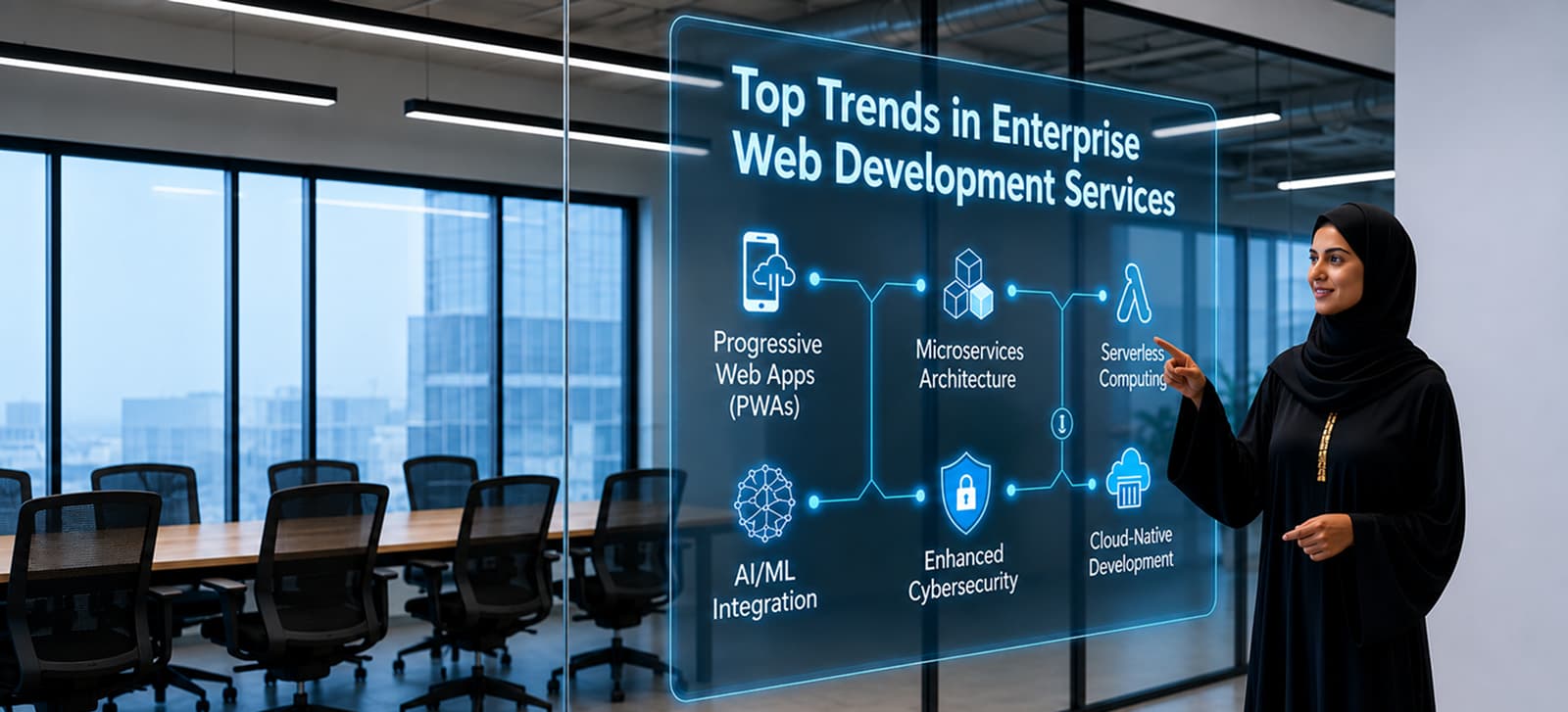
The 2026 landscape is transforming, and enterprise web development services are pivoting from just a digital storefront to the central system for global business operations. Driven by agentic AI, advanced computing, and highly personalized user experiences, modern web platforms are now judged on their ability to automate complex workflows and provide instantaneous, secure interactions.
For organizations looking to maintain a competitive edge, understanding the latest web development trends has become a business imperative. At Element8, we specialize in navigating these shifts, ensuring your enterprise website development is future-proof, scalable, and high-performing.
AI-Powered Web Experiences Become Standard
AI is no longer just a feature; it is the foundation of everything we do. AI in web development has transitioned from basic chatbots to agentic AI systems capable of autonomous decision-making and real-time UI optimization.
How AI Is Reshaping Enterprise Websites
- Hyper-Personalization at Scale: AI can now analyze user data, location, browsing behavior, and purchase history in real-time to customize content and layouts for each visitor.
- Intelligent Conversational AI: Generative AI assistants now handle complex multi-step inquiries, reducing the load on human support teams while boosting customer satisfaction.
- AI-Assisted Coding and Development: By 2026, AI-driven workflows will accelerate development cycles, enabling automated design-to-code handoffs and rapid prototyping.
- Predictive Analytics: Websites now proactively adjust elements based on predicted user needs, significantly increasing conversion rates.
Business Impact: The main benefit for enterprises is operational efficiency. By automating content updates and support, companies can now lower the operational costs while seeing a marked increase in user engagement and sales through AI-powered websites.
Headless CMS and Composable Architecture Continue to Rise
Headless CMS and composable architecture are now replacing traditional monolithic systems. In 2026, over 80% of large enterprises have adopted these decoupled systems to manage the increasing complexity of digital touchpoints.
The Rise of the “Lego” Approach
By separating the frontend (presentation layer) from the backend (content repository), enterprises gain unprecedented flexibility.
- API-First Development: Using an API-first architecture, content is delivered seamlessly across websites, mobile apps, IoT devices, and even in-store displays.
- The MACH Principles: Modern stacks are built on Microservices, API-first, Cloud-native, and Headless technologies.
- Performance & SEO: Performance & SEO: For enterprises targeting better search visibility, understanding how a headless CMS improves SEO in Saudi Arabia can help improve speed, content delivery, and technical performance.
Key Takeaway: Composable architecture avoids vendor lock-in, allowing enterprises to swap out specific tools (like payment gateways or search engines) without rebuilding the entire platform.
Progressive Web Apps (PWAs) Replace Traditional Mobile Experiences
Progressive web apps are becoming a preferred solution for enterprises seeking app-like experiences without the complexity and cost of native mobile development.
PWAs combine the best features of websites and mobile apps while delivering fast, responsive, and highly accessible experiences directly through browsers.
Why Enterprises Are Investing in PWAs:
- Lower Development Costs: Maintain a single codebase for all platforms.
- Offline Functionality: Service workers enable PWAs to operate in low-connectivity environments, ensuring continuous access to business tools.
- Instant Updates: Users always have the latest version without needing to visit an app store.
- App-Like Performance: PWAs provide smooth navigation, push notifications, and home-screen icons, delivering a native feel within the browser.
<a href="/cyber-security-company">Cybersecurity</a>-First Development Becomes Essential
As enterprises manage increasing amounts of customer data, APIs, cloud infrastructure, and digital transactions, cybersecurity in web development has become a business-critical priority.
Secure-by-design development is now essential for protecting enterprise web applications from evolving cyber threats.
For enterprises handling sensitive customer information and large-scale API ecosystems, cybersecurity incidents can result in:
- Operational disruption
- Regulatory penalties
- Revenue loss
- Reputational damage
- Customer trust erosion
Key Security Trends in 2026:
- Zero-Trust Architecture: A “never trust, always verify” model for every user and device.
- AI-Driven Threat Detection: Real-time identification and blocking of bot traffic and fraudulent transactions.
- API Security: As enterprises become more interconnected, securing the “connectors” between services is paramount.
- Privacy-First Compliance: Automated tools ensure that global data privacy regulations (like GDPR or local Saudi data laws) are met by default.
Cloud-Native Development and Serverless Architecture
Cloud-native web applications are becoming the foundation of scalable enterprise digital infrastructure.
Modern enterprises increasingly rely on cloud-native technologies to build agile, resilient, and high-performance platforms capable of supporting global operations.
What Is Driving Cloud-Native Adoption?
- Scalability and Elasticity: Systems automatically scale during traffic spikes and “scale-to-zero” when idle, optimizing costs.
- Edge Computing: Processing data closer to users at the “edge” (e.g., Cloudflare Workers) can minimize latency to nearly zero.
- Reduced Management: Serverless solutions such as AWS Lambda and Google Cloud Functions remove the burden of patching and server management for IT teams.
Technologies Driving Cloud-Native Development
Enterprises are increasingly adopting:
- Kubernetes
- Docker containers
- Multi-cloud infrastructure
- Serverless computing
- Edge rendering technologies
- CDN optimization platforms
Cloud-native architecture is becoming essential for scalable web infrastructure and enterprise modernization.
Hyper-Personalization and Data-Driven UX
In 2026, enterprise UX is becoming increasingly data-driven and adaptive.
Modern enterprise websites now function as intelligent systems capable of continuously optimizing digital experiences based on user behavior and intent.
What Hyper-Personalization Looks Like
- Dynamic Content Delivery:Website layouts and messaging adapt in real time based on audience behavior and engagement patterns.
- Behavioral Analytics: AI-powered analytics help enterprises understand:User journeys, Friction points, Engagement behavior,Conversion barriers
- Customer Journey Optimization: Real-time personalization improves:Engagement, Lead quality, User satisfaction, Revenue generation
- AI-Powered UX Adaptation:Enterprise websites can now dynamically optimize interfaces to guide users toward the most efficient conversion path.
Low-Code and No-Code Tools Accelerate Enterprise Development
Low-code and no-code platforms are helping enterprises accelerate digital transformation by enabling faster application deployment and improved collaboration between business and IT teams.
These tools are increasingly used for:
- Workflow automation
- Internal tools
- Rapid prototyping
- Business process optimization
Why Enterprises Are Adopting LCNC Platforms
Faster Application Deployment: Teams can build and deploy solutions significantly faster than traditional development cycles.
Improved Collaboration: Business teams can participate directly in application development workflows.
Reduced Development Bottlenecks:Simple applications and automation tasks can be handled outside core engineering teams.
Rapid Innovation: Enterprises can test and validate ideas quickly without major infrastructure investment.
Advanced Frontend Frameworks and Modern UX Standards
The 2026 web is immersive and accessible.Choosing the best tech stack for enterprise websites is essential for building scalable, secure, and high-performing platforms that support long-term digital growth. Modern frontend frameworks allow for:
- Motion UI: Subtle animations that guide user attention without sacrificing speed.
- Accessibility-First Design: Ensuring compliance with global legal mandates so that digital tools are usable by everyone, regardless of disability.
- Micro-Frontends: Breaking the frontend into modular, manageable pieces that large teams can work on independently.
Technologies such as React, Next.js, Vue, Angular, and Astro are enabling enterprises to develop highly responsive enterprise web applications with improved performance, SEO capabilities, and maintainability.
Voice Search and Conversational Interfaces
Voice-enabled interfaces and conversational experiences are becoming increasingly important in enterprise website development.
As AI assistants and connected devices continue to grow, enterprises must prepare for non-visual interactions and natural language experiences.
- Voice-Enabled Platforms: Allowing users to navigate complex enterprise dashboards via voice commands.
- Conversational Commerce: Facilitating transactions through natural language processing (NLP).
What Enterprises Should Prioritize in 2026
To thrive in this environment, enterprises should focus on three core pillars:
- Modernize Legacy Systems: Move away from monolithic architectures toward headless CMS and composable stacks. Before modernization begins, enterprises should also evaluate common enterprise web development challenges and solutions, including scalability issues, integration gaps, security risks, and legacy system limitations.
- Invest in Agentic AI: Shift from passive tools to active AI agents that improve the user experience.
- Adopt a Security-First Mindset: Protect brand reputation by making cybersecurity a core part of the development lifecycle.
Enterprises that delay modernization risk falling behind competitors adopting AI-driven automation, cloud-native scalability, and composable digital ecosystems.

Partner with Element8 for Enterprise Web Development
Navigating modern enterprise web development trends requires a strategic technology partner capable of aligning innovation with measurable business outcomes.
At Element8, we help enterprises build scalable, AI-powered, cloud-native, and secure digital platforms tailored for long-term growth, operational efficiency, and enterprise digital transformation.
From enterprise website development and headless CMS implementation to cybersecurity-first architecture and intelligent automation, our team delivers future-ready web solutions designed for modern business demands.
Ready to modernize your enterprise web platform?
Request a consultation with Element8 to evaluate your current digital infrastructure, identify modernization opportunities, and build a scalable web strategy for 2026 and beyond.