


Native vs Cross-Platform Mobile App Development: Which Is Right for Your Business App?
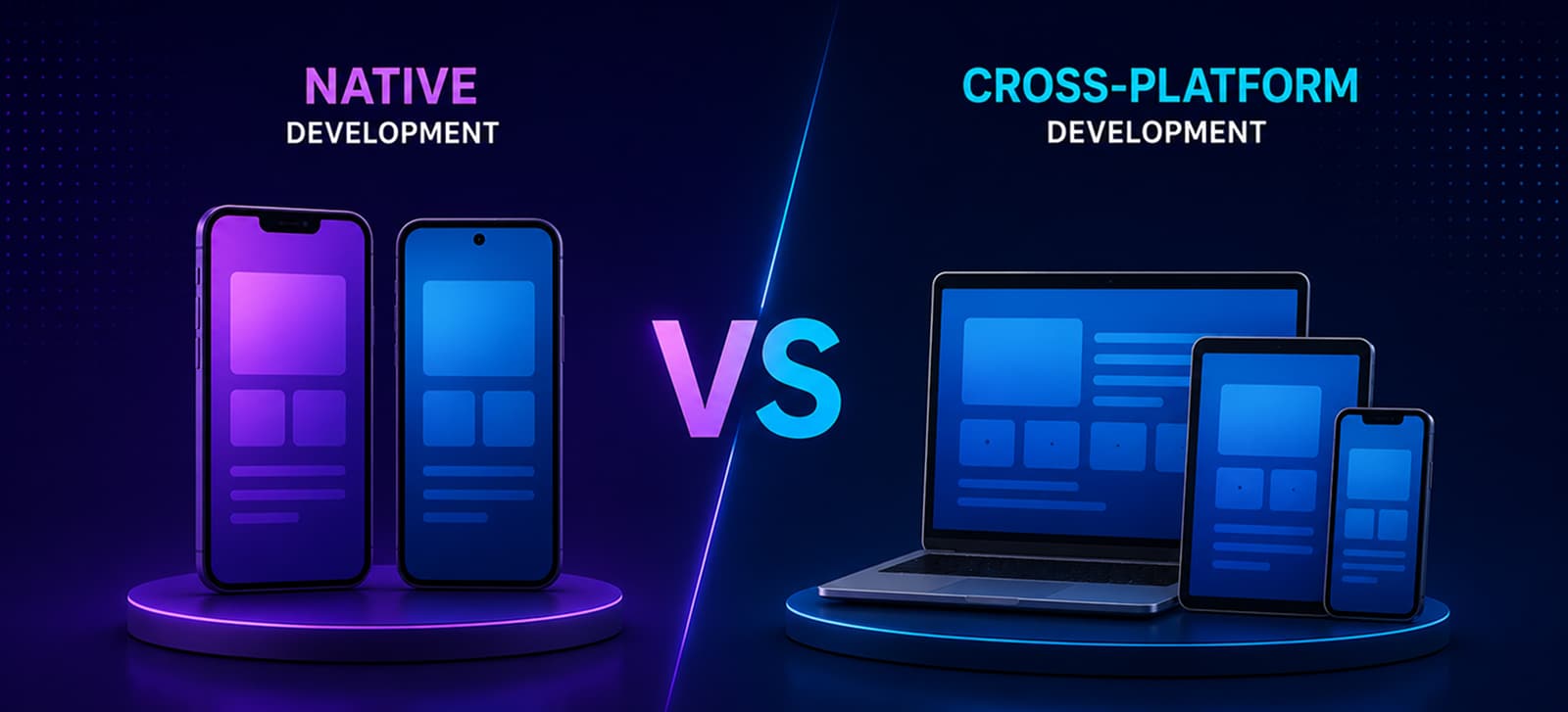
To choose the right mobile application architecture is one of the most important decisions a business leader can make before entering the digital marketplace. The digital economy is moving rapidly, and launching a mobile app will require a strategic balance between development speed, initial capital expenditure, long-term maintenance costs, and user experience.
When evaluating native vs cross-platform mobile app development, organizations must consider factors such as performance, scalability, development costs, maintenance requirements, and long-term business goals.
Two primary methodologies that are dominating the market are native app development and cross-platform app development. Both approaches offer distinct advantages, but they also serve fundamentally different business objectives. Choosing the wrong framework can lead to technical debt, inflated budgets, or subpar user interfaces that can alienate your target audience.
For businesses considering mobile app development in Saudi Arabia, understanding the differences between native and cross-platform development is essential. The right decision will influence project costs, development timelines, user experience, scalability, and long-term maintenance requirements. This guide explores both approaches to help you make an informed business decision while aligning your app strategy with long-term business goals.
What is Native App Development?
Native app development is the process of engineering a mobile application exclusively for a specific operating system (OS). To achieve this, software developers build the product using the platform’s officially supported programming language, software development kits (SDKs), and integrated development environments (IDEs).
If your goal is to capture market share on both major platforms, native development requires you to execute two entirely separate software development life cycles from scratch.
The Core Ecosystems
The modern mobile landscape is strictly divided between two major architectural ecosystems:
- Apple iOS: Applications are built using Swift or Objective-C. Developers use these technologies within the Xcode IDE, a development environment optimized specifically for macOS. Organizations investing in iOS app development can use Apple’s tightly controlled ecosystem to deliver highly secure, high-performance digital experiences.
- Google Android: Applications are written using Kotlin or Java. Businesses investing in Android app development benefit from access to the world’s largest mobile operating system ecosystem and a broad range of consumer devices.
What is Cross-Platform App Development?
Cross-Platform app development is the engineering practice of creating a single, centralized codebase that compiles and executes across multiple mobile operating systems. Instead of partitioning your engineering efforts into isolated platform silos, your development team writes a singular code repository that powers both iOS and Android versions of your digital products.
Key Advantages for Businesses
- Substantial Cost Reduction: By utilizing a single development team to build one unified application layer, enterprises routinely slash engineering overhead by 30% to 40% compared to dual-track native projects.
- Rapid Time-to-Market (TTM): Managing a single development pipeline allows companies to deploy functional applications to public app stores far faster. This rapid cycle is highly beneficial for launching Minimum Viable Products (MVPs) or executing agile market iterations.
- Homogeneous Brand Presentation: Because the visual layout and core functionalities stem from the same repository, your application maintains an identical feature set, visual layout, and branding across all consumer devices.
Popular Cross-Platform Frameworks
Several production-grade frameworks anchor the modern cross-platform software ecosystem:
- React Native app development: Developed and backed by Meta, this framework enables engineers to write mobile applications using JavaScript and React. It bridges your JavaScript components directly into native UI widgets, delivering a highly responsive user experience.
- Flutter app development: Created by Google, Flutter utilizes the Dart programming language. It skips native UI bridges entirely by using its own high-performance rendering engine (Impeller/Skia) to draw every pixel of the user interface directly onto the screen, ensuring absolute design fidelity.
- Kotlin Multiplatform (KMP): A modern, flexible approach that allows developers to share core business logic (such as data storage, networking, and analytics) across platforms while letting teams craft separate, entirely native user interfaces for iOS and Android.
Native vs Cross-Platform App Development: Key Differences

To help your executive team objectively evaluate these two development methodologies, we have structured a high-level technical matrix comparing their operational characteristics.
Native App Development
When opting for a native architecture, your enterprise commits to building applications using the native ecosystem’s official SDKs. This choice unlocks several structural advantages:
- Hardware and Computational Precision: Native code executes directly on the device’s central and graphics processors without intermediate translation layers. This ensures sustained rendering at 60 FPS or 120 FPS.
- Granular System Integration: Native builds interact seamlessly with deeply embedded device background modes, complex thread scheduling, and intricate hardware arrays, such as advanced Bluetooth Low Energy (BLE) handshakes or Augmented Reality (AR) spatial meshes.
- Comprehensive Cybersecurity Compliance: Native architectures can easily tap into platform-exclusive cryptographic libraries, secure file-system storage models, and sandbox-level anti-fraud utilities, making them the preferred architecture for highly regulated environments.
Cross-Platform App Development
Cross-platform development relies on sharing up to 90% of your application’s core business logic across both operating systems. However, this unified approach introduces specific operational trade-offs:
- Unified Maintenance and Bug Mitigation: When a bug is identified in the core application logic, your developers write, test, and push a single patch that resolves the issue on both iOS and Android simultaneously.
- Third-Party Plugin Dependencies: If Apple or Google releases an advanced system capability (such as a new lock screen widget or an updated privacy-tracking control), your engineering team may face delays. They often must wait until the open-source community or the framework’s maintainers release a wrapper plugin to expose the new platform APIs in the cross-platform environment.
Cost Comparison: Native vs Cross-Platform App Development
Understanding mobile app development cost is one of the most important considerations for organizations evaluating native and cross-platform architectures. From an economic perspective, building a cross-platform mobile application is generally 30% to 40% more cost-effective upfront. It cuts total development time by roughly 40% compared to launching two discrete native apps.
By unifying your front-end development around a single stack such as Flutter or React Native, you eliminate the need to run two separate engineering pipelines, substantially reducing both your initial capital investment and your ongoing software maintenance costs.
Budget & Project Timeline Projections
While the final cost of any custom software depends heavily on its functional scope, integrations, and architectural complexity, the following table illustrates the typical financial and timeline deviations seen across the industry.

Strategic Advantages of Cross-Platform Financial Models
- Reduced Engineering Requirements: Because your team writes a single codebase, you do not need to hire separate, platform-specific UI engineers. This optimizes your initial budget allocation.
- Accelerated Market Valuation: Launching an app quickly allows startups and enterprise innovation teams to validate their product-market fit, gather real user metrics, and secure venture capital or internal stakeholder backing ahead of the competition.
- Simplified Operational Structure: Managing a single unified team with a single task backlog minimizes administrative friction, streamlines quality assurance testing, and ensures product updates ship simultaneously.
Strategic Advantages of Native Financial Models
- Long-Term Enterprise Stability: Native codebases eliminate reliance on middle-layer software frameworks. This ensures your application remains completely stable throughout its multi-year lifecycle, free from the risk of breaking changes due to framework deprecations.
- Minimized Optimization Costs: If your product requires highly complex custom animations, real-time background location processing, or heavy rendering workflows, optimizing a cross-platform app can sometimes require extensive, expensive custom native bridges. Starting with a native architecture avoids this technical debt entirely.
Performance and User Experience Comparison
When comparing performance and user experience, native development generally delivers the highest level of optimization because applications are built specifically for a single operating system. However, modern cross-platform frameworks have significantly improved and now provide performance levels that meet the needs of most business applications.
As modern applications increasingly incorporate artificial intelligence features such as recommendation engines, predictive analytics, and conversational assistants, optimizing both performance and user experience becomes even more critical. Businesses exploring AI-powered applications should also consider how AI functionality impacts mobile UX, scalability, and responsiveness.
Cross-platform frameworks handle everyday UI rendering in slightly different ways:
- React Native converts your JavaScript components into real native system widgets. While this delivers an exceptionally authentic look and feel, passing data across the asynchronous “bridge” between the JavaScript engine and the native UI layer can create visual stuttering during high-frequency animations or heavy data scrolling.
- Flutter bypasses native system widgets entirely. It treats the mobile screen as an open visual canvas, rendering every button, menu, and input form pixel-by-pixel using its own high-speed graphic engine. This architecture ensures complete visual consistency across iOS and Android, but it requires the application to include its own rendering engine, resulting in a larger initial download size for consumers.
How to Choose the Right Approach for Your Business App
To select the ideal architecture path, you will need an objective analysis of your current business constraints, operational capabilities, and product requirements. The right architecture decision can significantly impact the success of your business mobile app development strategy, influencing scalability, performance, and long-term maintenance costs. Whether you are planning an enterprise platform, customer-facing application, or custom mobile app development project, the architecture you choose will directly affect performance, scalability, and future enhancements.
To help guide your decision, we have distilled this choice into a structured, business-focused framework based on four key operational pillars:
-
Product Complexity & Core Tech Stack
Choose Native: If your application relies on advanced device capabilities—such as real-time biometrics, continuous background geolocation tracking, intricate Bluetooth low-energy hardware syncing, or intensive 3D graphic rendering (like AR/VR environments).
With cross-platform frameworks, building an app that relies heavily on custom hardware integrations still requires writing platform-specific native code wrappers anyway. This undermines the core benefit of using a shared codebase.
-
Market Launch Timeline & TTM Velocity
Choose Cross-Platform: If you are a startup looking to establish an immediate market presence, launching an MVP to secure early customer feedback, or racing to deploy a functional digital product ahead of a strict industry deadline.
Maintaining a single codebase allows you to design, build, and deploy your product to both the Apple App Store and Google Play Store concurrently, giving you maximum market reach on launch day.
-
Financial Budgets & Team Resources
Choose Cross-Platform: If your capital budget is constrained or you want to keep your internal engineering team lean.
Instead of funding separate iOS and Android development teams, a cross-platform strategy allows a single team of versatile developers to manage your entire front-end customer experience.
-
Target Demographics & Regional Market Share
Choose Cross-Platform: If your target audience is evenly distributed across both operating systems.
In markets like Saudi Arabia, where consumer preferences span both high-end iOS devices and a broad spectrum of Android smartphones, ensuring your application launches on both storefronts simultaneously is essential to maximizing your addressable market.
How Element8 SA Helps with Mobile App Development
Navigating the complexities of mobile software architecture requires a trusted, highly experienced digital partner.As a leading mobile app development company in Saudi Arabia, Element8 helps businesses identify the most suitable development approach based on their objectives, budget, target audience, and long-term growth strategy.
Whether your organization requires the raw execution power and robust security of a custom mobile app development native pipeline, or the rapid deployment advantages of a Flutter app development or React Native app development codebase, our veteran team of software architects, UI/UX designers, and systems engineers will guide you from initial discovery through post-launch scaling. Our team specializes in:
- Native iOS app development
- Native Android app development
- Flutter app development
- React Native app development
- Enterprise mobile applications
- Custom mobile app development
- UI/UX design and optimization
- Ongoing maintenance and scaling
We work closely with your stakeholders to analyze your product’s technical requirements, project timeline, and budget constraints. This ensures we deliver a highly stable, exceptionally secure, and deeply scalable mobile application that drives measurable business growth.
Partner with Element8 to transform your digital vision into a powerful, market-leading mobile asset.