For many years, the standard all-in-one platforms dominated the web development industry. However, the rise of omnichannel customer journeys, strict search engine performance requirements, and the integration of artificial intelligence into search algorithms have fundamentally reshaped the demands of digital development. To choose the right architecture can directly impact your organization’s long-term scalability, operational costs, search engine visibility, and user retention.
What Is a Monolithic CMS?
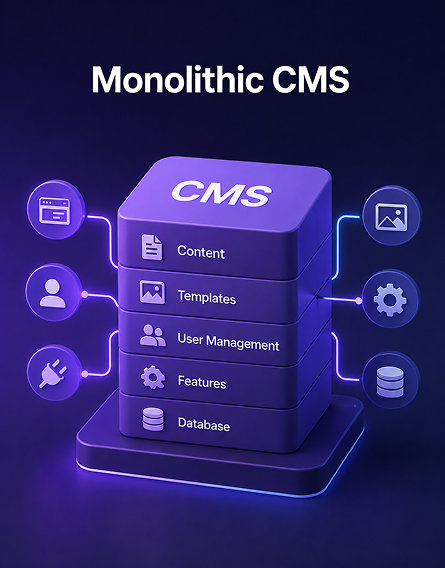
A monolithic CMS, often referred to as a traditional CMS, is an all-in-one software platform in which the content management backend and the frontend presentation layer are tightly coupled within a unified system. In this architecture, the database, content creation dashboard, media library, and design template exist under a single software umbrella.
Key Characteristics of Monolithic Systems
- Coupled Architecture: The backend database that stores text, files, and assets is fundamentally dependent on the frontend templates that present them.
- Built-in Presentation Layer: The CMS relies on native themes, stylesheets, and templating engines (such as PHP in WordPress) to format content specifically for desktop and mobile web browsers.
- WYSIWYG and Page Builders: These platforms offer robust, visual “What You See Is What You Get” editors, enabling marketers to build layouts, drag-and-drop components, and instantly preview exact page styling.
- Popular Examples: Well-known monolithic platforms include WordPress, Drupal, HubSpot CMS, Joomla, and Sitecore.
Advantages of a Monolithic CMS
For many organizations, the traditional model will remain highly practical. Its primary benefit is a low barrier to entry. As the environment is pre-integrated, deployment is exceptionally rapid. Small and medium-sized businesses can launch complex marketing websites or blogs easily by utilizing the platform’s massive ecosystem of pre-built themes and functional plugins.
Furthermore, monolithic platforms are highly intuitive for non-technical marketing teams. Content creators can draft copy, modify site layouts, manage SEO parameters via user-friendly add-ons, and publish updates independently without relying on an engineering team. Ongoing infrastructure management is simplified as all assets, user permissions, and design components are managed in a single dashboard.
Limitations of a Monolithic CMS
Despite its accessibility, traditional CMS architecture can present distinct operational bottlenecks for expanding enterprises:
- Omnichannel Delivery Constraints: Because a traditional CMS is engineered fundamentally to output HTML for web browsers, delivering content seamlessly to custom iOS/Android apps, smart wearables, IoT displays, or digital signage requires complex, custom workarounds.
- Performance and Scalability Bottlenecks: As a corporate website grows, the accumulation of custom plugins, heavy database tracking, and simultaneous front-end and back-end requests can degrade site speed. High traffic spikes force the entire system to scale at once, which increases infrastructure costs.
- Rigid Customization Options: Front-end engineering choices are constrained by the CMS’s underlying architecture. If a brand requires a radical interface redesign or a shift to a modern JavaScript framework, it often demands a costly, ground-up backend rebuild.
- Heightened Security Risks: Because the administration dashboard and public-facing frontend share the same server space and code environment, a vulnerability in a third-party plugin can compromise the entire corporate database.
What Is a Headless CMS?
A headless CMS is a backend-only content management system where the content repository (the structural “body”) is completely decoupled from the presentation layer (the visual “head”). Instead of dictating how content is styled or rendered on a specific webpage, a headless CMS acts exclusively as a centralized data repository. It can store structured, presentation-agnostic data and distribute it securely to any device via fast application programming interfaces (APIs).
How Headless Architecture Works
- The Backend (The Body): Marketers and copywriters log in to an intuitive, cloud-based administrative dashboard to create, categorize, and organize structured content fields (e.g., text, images, product data) that are completely isolated from design styling.
- The API Gateway: The content is delivered as lightweight, highly secure, unstyled data payloads (typically via REST or GraphQL APIs) across a decentralized network.
- The Frontend (The Head): Engineering teams are empowered to build highly customized visual interfaces using modern, high-performance frontend frameworks (such as React, Next.js, Vue.js, Nuxt.js, or Astro). The frontend dynamically requests the clean content from the API and renders it flawlessly to the end consumer.
Why Choose a Headless CMS?
- True Omnichannel Distribution: Write your content once and syndicate it everywhere. The same backend repository can stream data simultaneously to your main website, a regional mobile application, enterprise customer portals, or in-store interactive kiosks.
- Unmatched Developer Freedom: Engineers are liberated from legacy template constraints. They can select modern programming ecosystems that match your technical requirements, resulting in highly dynamic, bespoke user interfaces.
- Substantial Performance Gains: By separating database management from public interactions, pages can be statically generated or pre-rendered via Content Delivery Networks (CDNs). This ensures rapid load speeds, which boosts user engagement.
- Enterprise-Grade Security: Because the core database that hosts your company’s information is completely hidden behind an API gateway and separated from the public-facing website, the external attack surface is significantly reduced.
- Simplified Tool Integrations: Operating on a native API-first foundation, a headless CMS integrates with a modern tech stack%2LS����