


Why Saudi Businesses Are Moving to Headless CMS for Faster Websites and Better SEO
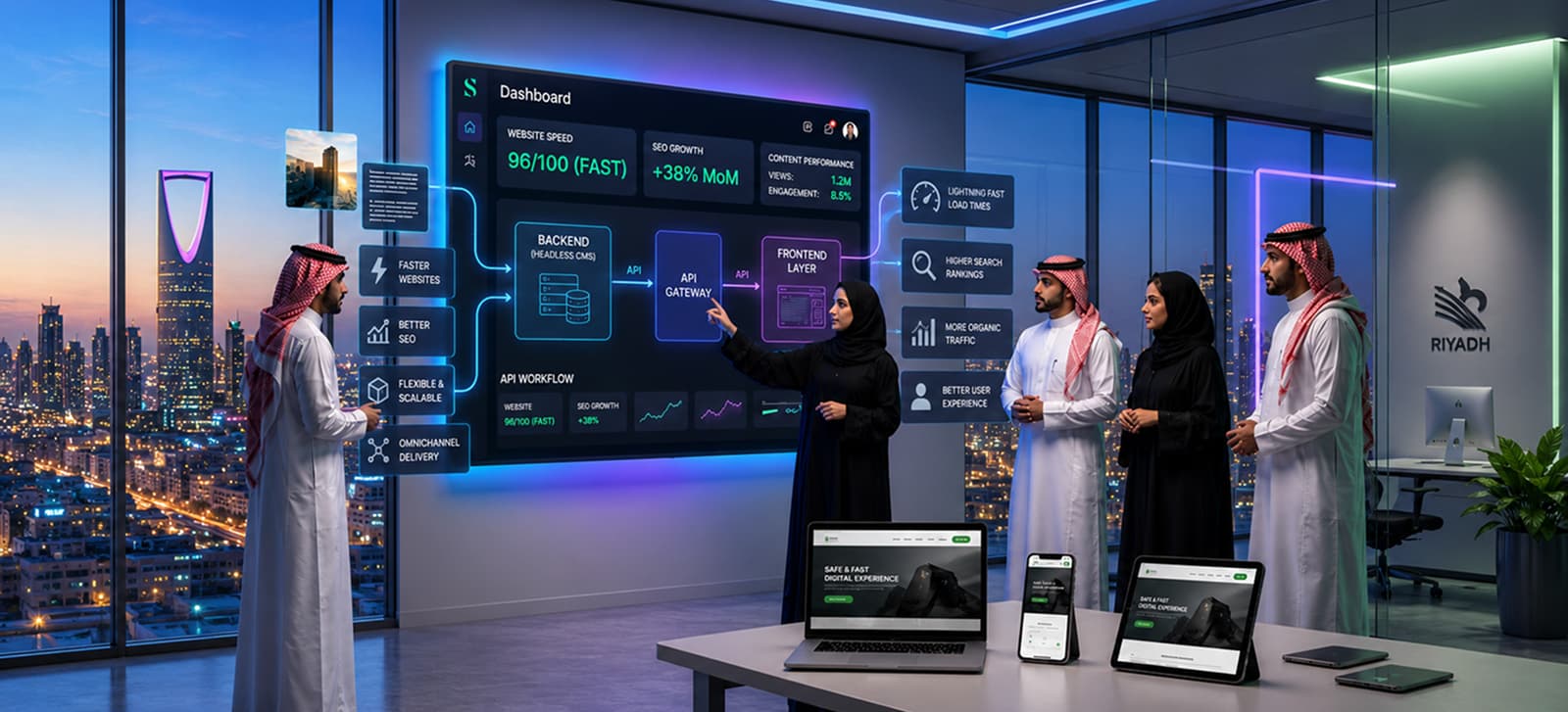
The digital landscape of Saudi Arabia is transforming, and the race for online supremacy is no longer just about having a website. It is all about speed, agility, and search engine dominance. As the kingdom is marching towards the ambitious goals of Vision 2030, digital transformation has moved from a luxury to a baseline requirement for survival.
An important factor in this transformation is the fundamental shift in how websites are built. Forward-thinking Saudi enterprises are pivoting away from restrictive, traditional platforms and embracing headless CMS for SEO and performance. As enterprises move toward composable digital ecosystems, understanding the core benefits of headless CMS architecture becomes critical for long-term scalability and SEO success.
By decoupling the backend content storage from the frontend display, businesses are achieving near-instant load times and superior search visibility.
Why Traditional CMS Platforms Struggle With Performance
For many years, monolithic platforms such as WordPress and Drupal were the go-to solutions. However, their “all-in-one” architecture is now becoming a bottleneck for modern enterprise website performance.
The Burden of Monolithic Inflexibility
In a traditional CMS, the frontend and backend are tightly coupled. Every time a user visits a page, the server must process heavy PHP code, query a database, and render the HTML in real-time. This “monolithic” design can mean that backend changes inadvertently break the frontend, making scaling difficult for growing Saudi brands.
Plugin Bloat and Code-Heavy Themes
The traditional system usually relies on a mountain of plugins to add basic functionality. Each plugin adds layers of JavaScript and CSS, leading to plugin bloat. This excessive code increases the “weight” of the page, crushing headless CMS site speed before the user even sees the first pixel.
Issues with Core Web Vitals
Google’s Core Web Vitals optimization has now become the primary ranking factor. Traditional CMS platforms struggle with:
- LCP (Largest Contentful Paint): Slow server response times delay the loading of main content.
- FID (First Input Delay): Heavy JavaScript execution makes pages unresponsive during load.
- CLS (Cumulative Layout Shift): Tightly coupled themes often cause elements to jump around during loading.
How Headless CMS Improves Website Speed
The superior performance of headless CMS compared to traditional setups stems from its architectural “separation of concerns.” By decoupling the backend from the frontend, the CMS focuses solely on delivering raw data via an API, allowing the frontend to be built using modern, lightweight tools optimized for speed.
Static Site Generation (SSG) and Pre-rendering
Unlike traditional sites that build pages on the fly for every visitor, a headless setup typically uses Static Site Generation (SSG).
- Pre-rendered Pages: Tools like Next.js pre-render every page of your website into static HTML files during deployment.
- Faster Loading: Since the pages already exist as files, they are delivered instantly to the browser.
- Reduced Server Requests: By removing the need for real-time database queries, you eliminate the “wait time” typically associated with server processing.
CDN and Edge Delivery in the GCC
Because the frontend consists of static files, it is perfectly suited for hosting on a Content Delivery Network (CDN).
- Global Content Delivery: Your site is distributed across a network of global servers.
- Lower Latency in Saudi Arabia/GCC: For Saudi businesses, content is cached on edge servers physically located within the Kingdom. This ensures that a user in Riyadh or Jeddah receives data from a local node, making the website feel instantaneous.
Lightweight Frontend Frameworks
Headless architecture allows developers to move away from heavy, rigid templates and use modern frameworks like Next.js, React, or Vue.
- Purpose-Built Interfaces: Developers can create high-performance interfaces that load only the code necessary for a specific page.
- Lower JavaScript Bloat: This modular approach prevents the browser from downloading unnecessary scripts, ensuring a “lightning-fast” experience even on 5G-enabled mobile devices.
Reduced Plugin Dependency
One of the biggest speed killers in traditional systems is the reliance on third-party plugins for basic features.
- Cleaner Architecture: Headless setups use a “best-of-breed” approach, integrating features via lean APIs rather than bulky plugins.
- Streamlined Code: By eliminating plugin bloat, the overall page weight is significantly reduced, leading to better Core Web Vitals scores.
Better Scalability During Traffic Spikes
Traditional websites often crash or slow down during high-traffic events like Ramadan sales or White Friday.
- Enterprise Reliability: Because the frontend is decoupled and served via a CDN, it can handle millions of concurrent users without putting any load on the CMS database.
- E-commerce Benefits: This ensures a consistent, fast shopping experience, protecting your conversion rates during the most critical times of the year for your business.
How Headless CMS Improves SEO
In the world of digital marketing, speed is a sub-factor of SEO, but a headless architecture can offer much deeper Jamstack SEO benefits than raw velocity alone.
Enhanced Technical SEO Control
Traditional CMS platforms often “auto-generate” HTML that is messy or hard for crawlers to parse. With headless website development, developers have 100% control over the Document Object Model (DOM). You can perfectly optimize:
- Custom Schema Markup: Inject precise JSON-LD structured data for rich snippets.
- Canonical Tags & Metadata: Manage tags dynamically without being forced into a plugin’s rigid structure.
- Next.js SEO: Utilize built-in components for image optimization and metadata management.
Faster Crawling and Indexing
Search engine bots have a “crawl budget.” If your site is slow, bots will crawl fewer pages, as headless sites (especially those using SSG) are incredibly lightweight. Search engine spiders can index your content faster and more efficiently.
Better International SEO for Arabic & English
For Saudi businesses, multilingual support is non-negotiable. Headless CMS platforms allow for a clean multilingual architecture. You can serve right-to-left (RTL) Arabic content and left-to-right (LTR) English content from the same backend, ensuring consistent Headless WordPress SEO across both languages without the performance hit of translation plugins.
Why Headless CMS Matters for Saudi Businesses
With one of the highest smartphone penetration rates globally and a young, tech-savvy population, the expectations for digital experiences are incredibly high.
- Vision 2030 Digital Transformation: Vision 2030 is not about the infrastructure; it is all about building a digital-first economy. Government entities and private enterprises are adopting composable architecture to remain agile. A headless CMS allows a business to update its website design without ever touching its core content database, providing the flexibility required for rapid growth.
- Mobile-First Users in KSA: With the Kingdom’s massive investment in 5G, users expect apps and websites to load in under 2 seconds. A headless CMS benefits mobile users by providing optimized, low-payload data that performs exceptionally well in mobile browsers and integrated apps.
- Enhanced Security for E-commerce: E-commerce in Saudi Arabia is booming. In a traditional CMS, the “head” (the website) is the same as the “body” (the database). If a hacker finds a vulnerability in a plugin, they have access to everything. In a headless setup, the CMS backend is hidden behind an API and is not publicly accessible, significantly reducing the attack surface.

Best Tech Stack for SEO-Focused Headless Websites
A successful headless implementation depends heavily on selecting a scalable website tech stack that supports speed, security, and future growth.
To maximize core web vitals optimization, we recommend the following “Power Stack”:
- Backend: Strapi or Contentful (for structured content management).
- Frontend: Next.js (The industry leader for Next.js SEO and performance).
- Deployment: Vercel or AWS Saudi Region (for ultra-low latency).
- Database: PostgreSQL or MongoDB.
- API: GraphQL (to fetch only the data you need, reducing payload size).
Impact on Saudi E-Commerce and Digital Growth
By 2026, Saudi e-commerce revenue is expected to hit record highs. High-traffic seasons put immense strain on traditional websites. Headless commerce allows brands to scale horizontally.
During a traffic spike, the static frontend (hosted on a CDN) can handle millions of visitors without the backend database ever feeling the pressure. This ensures that the shopping journey remains smooth, personalized, and most importantly, profitable.
While powerful, a headless approach isn’t for everyone.
Ideal For:
- Enterprise websites require high security and custom features.
- High-traffic e-commerce stores that can’t afford downtime.
- Multi-region businesses needing seamless Arabic/English localization.
- Content-heavy platforms (News, Government Portals).
Not Ideal For:
- Very small brochure websites with limited budgets.
- Simple blogs where the owner wants to manage everything without any developer help.
- Low-budget MVPs where speed of launch is more critical than long-term performance.

Future of Headless CMS in Saudi Arabia
The future is composable. We are moving away from “all-in-one” suites toward a “best-of-breed” approach. In the coming years, we expect to see:
- AI-Driven Content: Headless CMSs integrating with AI to automate content localization for the Saudi market.
- Omnichannel Ubiquity: Using one CMS to power a website, a mobile app, an in-store kiosk in Riyadh Park, and even wearable tech.
- Government Adoption: More G2C (Government to Citizen) services are adopting headless for its unmatched security and accessibility.
Ready to Build a Faster, SEO-Optimized Website? At Element8, we specialize in crafting high-performance digital experiences. We bridge the gap between complex technology and business growth by building enterprise-grade headless architectures designed for speed, security, and search engine dominance.
Talk to our headless development experts to build a future-ready digital platform today.