Building an AI-ready website requires more than new technologies; it demands a strategic approach to AI-ready website development that combines scalable architecture, structured data, and future-proof engineering.
Today, your website needs to serve two distinct audiences: human visitors seeking an intuitive user experience, and AI systems, large language models (LLMs), and autonomous systems seeking structured data. Whether it is ChatGPT recommending a local service, Gemini summarizing a product comparison, or Perplexity pulling direct answers, the way your business is discovered has been fundamentally changed.
Building a modern website is no longer about launching a static digital brochure; it requires a clean architecture, structured data, lightning-fast performance, organized content, secure integrations, and scalable backend systems. Businesses looking to build a future-ready digital presence should partner with an experienced web development company in Saudi Arabia, specializing in modern web development in Saudi Arabia, AI-ready architecture, and enterprise web technologies.
What Is an AI-Ready Website?
An AI-ready website is a digital platform designed and engineered to be easily crawled, understood, deeply parsed, and accurately recommended by AI systems and search engines. It ensures that machine learning algorithms do not have to guess what your business does; instead, they can extract clean, authoritative, and structured data to answer user queries or execute automated tasks.
Transitioning to an AI-ready framework requires a shift away from fluffy marketing language and toward absolute clarity across five core pillars:
-
Clear & Structured Content
- Semantic HTML5 Hierarchy: AI models rely on programmatic structures to understand content priority. Utilizing a clean nesting of semantic tags (<header>, <nav>, <main>, <article>, <section>, <footer>) along with logical heading hierarchies (<h1> down to <h4>) allows AI crawlers to scan, chunk, and extract key takeaways quickly.
- No Hidden Data Layers: Clunky JavaScript frameworks that render content only after complex user interactions, or critical business information trapped in flat, unstructured PDFs, create blind spots for AI crawlers. An AI-ready site ensures all core information is immediately accessible in the raw source code.
-
Machine-Readable Code
- Structured Data (Schema Markup): If standard code is the body of your website, Schema markup (JSON-LD) is its passport. Schema acts as an explicit “data receipt,” telling an AI agent exactly what it is looking at, whether that is a specific product SKU, a localized B2B service, exact operating hours, or organizational credentials. Implementing structured data for websites enables AI models to identify products, services, organizations, and other entities with greater accuracy, improving search visibility and machine understanding
- Standardized Text Alternatives: Advanced AI-ready architectures often provide ultra-clean, lightweight text alternatives (such as Markdown directories or llms.txt files) alongside the visual frontend layout. This allows automated systems to ingest core site content instantly without navigating bloated HTML or style scripts.
-
Clear Trust Signals & Authority
- Evidence-Based Content: Because modern AI engines are trained to minimize hallucinations, they prioritize high-authority, verifiable data. AI algorithms look for clear trust signals, such as in-depth case studies, verifiable performance metrics, comprehensive author bios, and explicit references.
- Consistent Metadata Ecosystem: All backend configurations. including Title tags, Meta descriptions, Open Graph protocols, and social previews, must align with the page’s visible text to prevent AI models from flagging the content as inconsistent or low-quality.
-
Controlled Access & Data Governance
- Agent-Specific Directives: Your robots.txt file and XML sitemaps are no longer just for Googlebot. A modern, AI-optimized architecture explicitly maps out boundaries for specific AI crawlers (like GPTBot or ClaudeBot), indicating which proprietary knowledge blocks are open for training and which are protected.
- Protocol Security: Implementing advanced authentication layers ensures that, while public-facing data is optimized for discovery, internal databases and proprietary business logic remain entirely secure against unauthorized machine extraction.
-
Actionable for AI Agents
- API-First Execution Layers: The future of the web belongs to autonomous commerce, where an AI agent executes actions on behalf of a human. An AI-ready website features securely exposed Application Programming Interfaces (APIs). This allows an external AI bot to perform actions directly on your site, such as instantly booking a consultation, verifying localized inventory, or initiating an enterprise query.
Why AI-Readiness Matters for Modern Businesses
Deploying AI tools randomly on top of an outdated web setup is a recipe for high bounce rates and technical debt. True AI-readiness acts as a foundation that aligns your data architecture, tech stack, and digital workflows to ensure long-term business scale. Without this preparation, organizations risk wasting development resources, poor search visibility, and stalled digital transformation initiatives.
Ensuring your corporate web infrastructure is fully AI-ready drives measurable enterprise outcomes across several key areas:
Trust, Reliability, and Hallucination Mitigation
AI engines amplify underlying data issues. If your website contains conflicting information, outdated service descriptions, or messy code, an LLM summarizing your business will likely output errors or hallucinate entirely. Clean, accurate, and governed data ensures that when an AI system cites your website, the output is highly trustworthy and accurate.
Cost Control and High Development ROI
Rushing into web development without an AI-centric blueprint often leads to broken integrations, poor indexing, and expensive re-engineering down the line. Designing a site with clean data models and decoupled frontends from day one minimizes long-term maintenance costs and maximizes your return on digital investment.
Extreme Operational Efficiency
An AI-ready digital framework naturally automates routine workflows. These AI capabilities are becoming particularly valuable in digital commerce, where intelligent product recommendations, predictive search, and automated customer interactions are transforming online shopping experiences. Learn more about AI in e-commerce websites and how businesses can leverage AI to improve customer engagement and conversions. By making your data instantly machine-readable, internal and external AI tools can pull real-time insights from your live product catalogs or service portfolios, eliminating manual data handling across your team.
Risk Mitigation & Compliance
Integrating your business with modern digital ecosystems changes how data is accessed and how cybersecurity threats evolve. Establishing clear data governance layers right on your website secures your endpoints, protects user privacy, and aligns your corporate footprint with emerging global compliance frameworks.
Sustainable Competitive Advantage
Websites that remain locked in traditional architectures will gradually disappear from AI-driven search results and conversational answers. Organizations that proactively align their digital infrastructure are better positioned to drive business innovation, adapt to rapid algorithm shifts, and capture market share ahead of their competitors.
Key Features of an AI-Ready Website
A strong AI website architecture forms the foundation of every intelligent digital platform, ensuring that both users and AI systems can access information efficiently. Comprehensive structured data for websites remains one of the most important technical requirements for AI-ready digital experiences. An AI-ready website combines advanced technical web development practices with a forward-looking content strategy. Here are the core technical components that must be baked into your digital footprint:
- Deep Semantic Content Modeling: Eliminates broad marketing fluff in favor of highly granular, factual, and question-based content blocks.
- Comprehensive Schema Markup (JSON-LD): Extensive entity-based schemas that define local businesses, corporate structures, product details, FAQs, and industry credentials.
- Ultra-Fast Performance & Core Web Vitals: Sub-second page load times and minimal layout shifts, which minimize crawl budgets for data-heavy AI crawlers.
- Clean, Code-Minimal Markup: Streamlined, semantic HTML that eliminates unnecessary script bloat, rendering pages highly readable for web scrapers.
- Headless CMS Architecture: A decoupled system that stores content as raw, pure data, completely separate from design templates.
- API-Ready Backend Frameworks: Secure, well-documented REST or GraphQL API endpoints built to facilitate autonomous machine interactions.
- Advanced Technical SEO Foundations: Strict handling of canonical tags, clean URL paths, dynamic XML sitemaps, and optimized robots.txt files.
- Enterprise-Grade Data Security: End-to-end encryption, strict API token management, and localized data compliance barriers.
- Scalable Component-Driven Frontend: Modular design components built with modern frameworks to ensure flexible deployment across multiple digital channels.
How Headless CMS Supports AI-Ready Websites
The traditional way of building a website is to lock content permanently inside visual page templates, as in standard, monolithic WordPress setups, creating a massive roadblock for artificial intelligence. AI agents do not care about your visual color themes of layout CSS; they care about the raw data. If you’re evaluating whether to migrate your website architecture, our guide on Headless CMS vs Traditional CMS explains the key differences, benefits, and use cases for modern businesses as you make the transition.
A Headless CMS for AI enables businesses to deliver structured content efficiently by separating the backend repository from the frontend presentation layer. Instead of generating rigid visual pages, a headless CMS outputs content as clean, highly structured, machine-readable data delivered easily via APIs. As AI adoption accelerates, implementing a Headless CMS for AI provides the flexibility required to support multiple digital channels and intelligent applications.
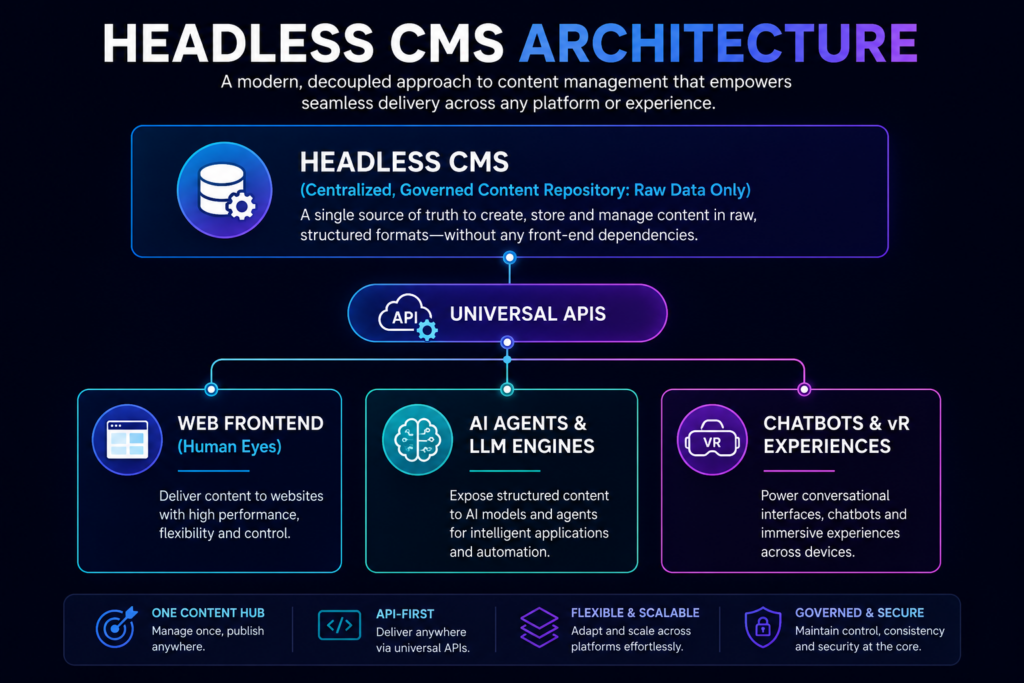
Adopting a headless CMS architecture provides several key advantages for AI optimization:
Structured Content Modeling
As a headless CMS does not use a fixed template, it will force your engineering and content team to break data down into granular, reusable fields such as separate fields for long titles, short headlines, explicit specifications, author credentials, and isolated summary bullet points. This semantic consistency can make your corporate data highly digestible for Large Language Models (LLMs) executing Retrival-Augmented Generation (RAG).
Universal API Delivery
Content is stored centrally and dynamically pushed out via GraphQL or REST APIs. This means that whether it is a human visitor loading your desktop site, a conversational voice app, an interactive chatbot, or an AI search crawler gathering data, every single channel pulls from the same governed source of truth in real time.
Enhanced Crawlability & Minimal Bloat
Search platforms that prioritize AI Overviews and automated summaries favor websites that eliminate heavy presentation code. Headless architectures eliminate the standard backend code bloat found in traditional content management systems, allowing AI web crawlers to parse your site’s hierarchy and underlying meaning with minimal processing effort.
Real-Time Dynamic Personalization
When your content is delivered as flexible API data, an integrated AI engine can analyze a user’s intent in real-time and instantly customize the experience. The AI can adjust the specific text fields or product recommendations served through the API to perfectly match the visitor’s device, localization, or context on the fly.
Automated Semantic Tagging
Many modern enterprise headless CMS platforms integrate directly with AI development tools. These tools automatically audit content on the fly, auto-generate hyper-accurate meta-descriptions, optimize complex headlines, and attach semantic metadata tags directly to the fields before they are ever published.
AI-Ready Website Architecture vs. Traditional Website Architecture
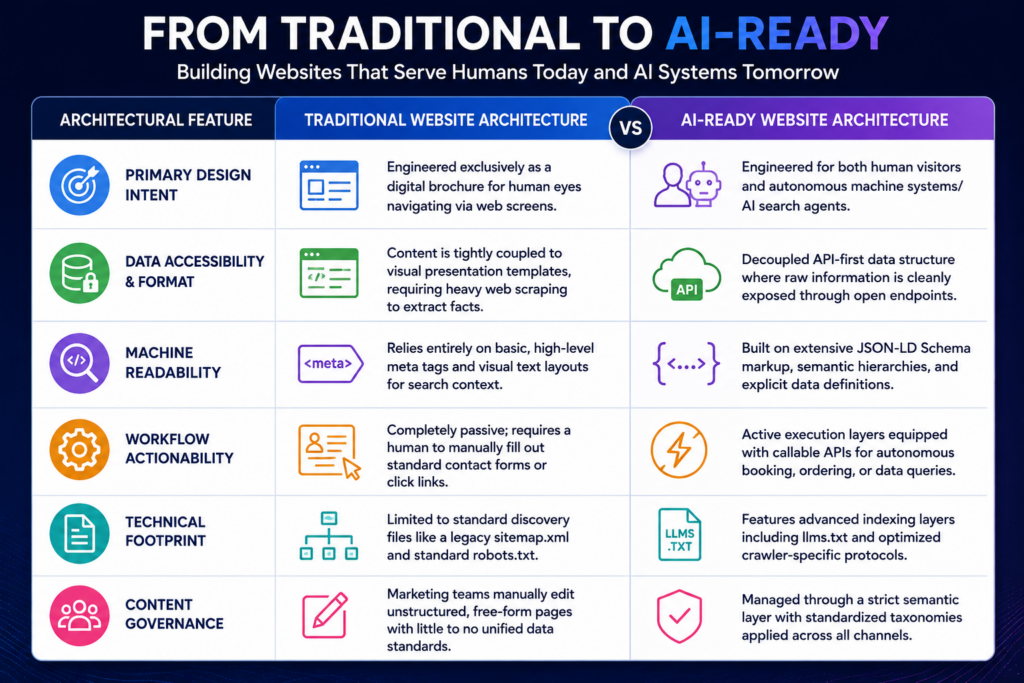
The transition from human-first web design to AI-centric discovery requires a fundamental shift in how digital infrastructure is engineered. Businesses investing in AI website architecture gain greater scalability, machine readability, and long-term digital resilience. The table below outlines the core differences between a legacy approach and a modern, AI-optimized web setup:
SEO and AI Search: What Businesses Should Prepare For
AI search, often referred to as Answer Engine Optimization (AEO) or Generative Engine Optimization (GEO), is fundamentally reshaping digital visibility. Successful AI search optimization requires businesses to create structured, authoritative content that AI-powered search engines can easily understand and reference. As search continues to evolve beyond traditional ranking factors, partnering with an experienced SEO company in Saudi Arabia can help businesses adapt their SEO strategies for both conventional search engines and emerging AI-powered search experiences. Winning in this environment is less about chasing individual keyword rankings and more about establishing deep, unassailable topical authority so that your brand is cited directly by models like ChatGPT, Gemini, and Perplexity.
To maintain visibility in an AI-driven search ecosystem, businesses must prepare for a complete restructuring of traditional SEO strategies:
The Core Shift: Keywords vs. Context
- Traditional SEO Focus: Optimizing pages around high-volume, short-tail keywords (e.g., “enterprise software development“) to drive click-through traffic to landing pages.
- AI Search (AEO/GEO) Focus: Optimizing content for long-tail, highly conversational, natural language queries (e.g., “What are the security requirements for integrating a headless CMS with an enterprise ERP system?”). The goal is to provide absolute contextual clarity so your business is pulled as the primary answer source or brand citation.
Actionable Preparation Strategies for AEO & GEO
Investing in AI search optimization today will improve visibility across conversational AI platforms and next-generation search experiences.
- Focus on “Search Everywhere” Optimization: AI models do not look at your website in a vacuum; they cross-reference data across the entire web. To validate your brand’s digital legitimacy, ensure your brand name, localized addresses, executive bios, and service offerings are consistent across all key digital directories, review platforms, and global knowledge graphs.
- Build Unquestionable Topical Authority: Because AI engines synthesize answers from multiple authoritative web nodes, your content must move away from generic copywriting. Shift your content strategy toward publishing first-party data, deeply researched white papers, expert internal quotes, and exhaustive, entity-based documentation.
- Structure Content for Direct Ingestion: Break down your primary service pages into distinct, hyper-focused sub-pages. Use highly explicit H2/H3 question headers and provide immediate, direct answers in the first two sentences of your paragraphs before diving into secondary technical nuance.
- Deploy Deep FAQ Modules: Create dedicated FAQ pages that target real-world user frustrations and operational questions. Answering these questions directly using clean text layouts makes your data incredibly easy for AI systems to pull, clip, and display as a featured answer snippet.
Why Saudi Businesses Should Start Building AI-Ready Websites
As the Kingdom of Saudi Arabia is accelerating its economic growth under the ambitious pillars of Vision 2030, digital transformation has pivoted from an operational luxury to a core national mandate. From Riyadh to Jeddah and across the Eastern Province, the local business ecosystem is digitizing at a work-class pace.
For Saudi enterprises, mid-market companies, and rapidly growing startups, building an AI-ready website is a critical step in future-proofing local market share for several distinct reasons:
-
Superior Customer Experience & Real-Time Personalization
Saudi Arabia features one of the youngest, most tech-savvy, and mobile-first populations in the world. Modern consumers do not want to spend minutes navigating complex, slow drop-down menus. An AI-ready web infrastructure enables Saudi brands to deploy hyper-personalized web layers, context-aware, predictive internal search, and highly responsive smart chatbots that instantly understand intent.
-
Bilingual Content Excellence (Arabic & English)
Operating successfully in the Saudi market requires flawless handling of both Arabic and English. Traditional web setups often create disjointed data structures between localized pages, causing AI systems to misinterpret cross-lingual context. An AI-ready framework built on an advanced backend natively handles multi-locale content modeling. This ensures AI search engines can crawl, understand, and recommend your brand accurately, whether a client queries in English or formal/colloquial Arabic.
-
Strict Compliance with Local Data Regulations
The Kingdom is rapidly expanding its digital infrastructure under the strict governance of the Saudi Data & AI Authority (SDAIA) and the Personal Data Protection Law (PDPD). Rushing into ungoverned web applications can quickly lead to costly security vulnerabilities and compliance infractions. An AI-ready website, engineered with clean data separations, structured access controls, and hosted on sovereign cloud infrastructure, ensures your enterprise remains fully compliant with all regional data storage and localization policies.
-
Direct Integration with the Local E-Commerce Ecosystem
The Saudi e-commerce sector is experiencing explosive growth, driven in large part by regional platforms like Salla and Zid, as well as complex, localized hyper-logistics networks. Building your web infrastructure with a modern, API-first architecture ensures your store can connect seamlessly with local payment gateways, AI-driven carrier scheduling tools, and automated inventory management setups.
-
Future-Proofing for Web Agents & Autonomous Commerce
The global web is shifting from a platform where humans manually read pages to an ecosystem where AI assistants perform tasks autonomously. Whether a business client uses an AI agent to source the top corporate logistics providers in Riyadh, or a consumer tasks an AI bot with booking the fastest HVAC repair service in Al-Nabhaniya, your digital presence must be machine-readable. If an AI assistant cannot parse your site code, your business will simply be left out of the selection pool.
Future-Proof Your Business with an AI-Ready Website
Building an AI-ready website is not about hastily installing basic AI plugins or using generic automated site builders that generate rigid code. It requires an intentional, deep restructuring of your digital architecture, technical SEO, and data delivery systems.
As an established leader in digital transformation and enterprise web development, Element8 is uniquely equipped to guide your business into the next era of the web. We partner with forward-thinking organizations across the Kingdom to engineer high-performance platforms built for long-term growth. Explore our Enterprise Web Development services to learn how Element8 designs scalable, secure, and AI-ready digital platforms tailored to the needs of growing businesses across Saudi Arabia.
Our comprehensive suite of specialized engineering services includes:
- AI-Readiness Audits & Digital Footprint Optimization
- Enterprise-Grade Headless CMS Strategy & Implementation
- Advanced Technical SEO & Answer Engine Optimization (AEO/GEO)
- Decoupled, High-Performance Frontend & Backend Web Development
- Custom API Development & Secure Enterprise Integration Layers
- Bilingual (Arabic-English) Semantic Content Modeling
- Data Governance, Local Compliance (SDAIA), and Security Architecture
The web is evolving rapidly, and the strategies that drove digital visibility over the past decade are no longer sufficient. True digital transformation requires moving past legacy web platforms and building an infrastructure that speaks the language of modern artificial intelligence.
An AI-ready website is not about adding a generic chatbot to your homepage or generating quick, automated content. It is about laying down a highly structured, fast, and scalable digital foundation that ensures your brand remains visible, authoritative, and actionable for both human buyers and the AI agents of tomorrow.
Planning a future-ready website? Element8 can help you build a scalable, SEO-friendly, and AI-ready digital platform designed for long-term business growth across the Kingdom.
Frequently asked questions
What makes a website “AI-ready” compared to a traditional website?
A traditional website is built to display information visually on screens for human users, often embedding data deep inside complex, rigid page layouts. An AI-ready website is explicitly engineered for both humans and machines. It separates raw data from design templates using an API-first architecture (like a Headless CMS). It utilizes detailed JSON-LD Schema markup to ensure AI engines can immediately extract, understand, and cite its content.
What is Answer Engine Optimization (AEO), and how does it change SEO?
Answer Engine Optimization (AEO) is the practice of optimizing your website content so it can be directly picked up, summarized, and cited by conversational AI engines like ChatGPT, Perplexity, and Google Gemini. Unlike traditional SEO, which focuses on earning page clicks through short keywords, AEO focuses on building context-driven authority and answering complex, long-tail, natural-language questions directly.
Why is a Headless CMS better than a traditional CMS for AI search engines?
A traditional CMS tightly locks your content into visual templates, making it difficult for AI crawlers to parse information without wading through heavy presentation code. A Headless CMS decouples your backend database from the frontend layout, serving your content as pure, clean, structured data via APIs. This code-minimal structure allows AI models to crawl your site faster, analyze your data hierarchy efficiently, and pull highly accurate information for user summaries.
How do I optimize my corporate website for AI agents and automated assistants?
To prepare your site for autonomous AI agents, you must implement deep semantic HTML hierarchies, structure your text into explicit question-and-answer formats, deploy comprehensive Schema markup, and maintain a highly consistent brand profile across all external business directories. Furthermore, exposing secure, well-documented API endpoints enables AI assistants to perform tasks on your site—such as scheduling appointments or querying real-time inventory.
How does an AI-ready website align with Saudi Vision 2030 and local compliance?
AI-ready websites support the digital economy goals of Saudi Vision 2030 by driving business automation, scalability in cross-border e-commerce, and advanced digital personalization. When built by an expert development team, an AI-ready site incorporates strict data governance layers that keep your data frameworks fully aligned with the privacy mandates set by the Saudi Data & AI Authority (SDAIA).