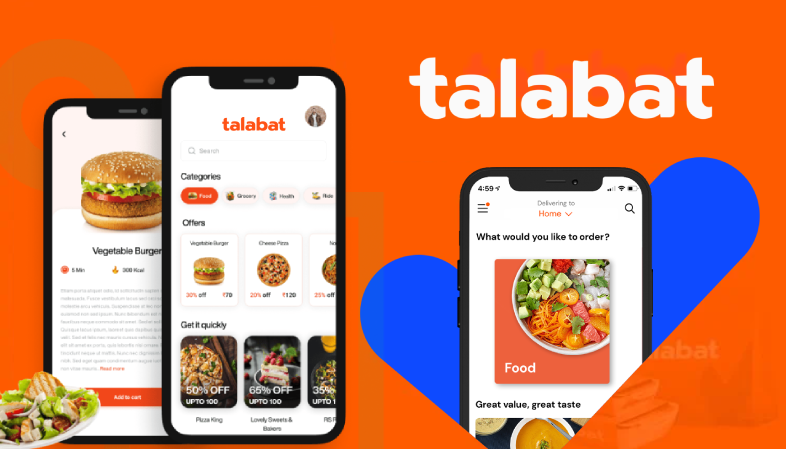
Grab a snack or order in with Talabat and read along to discover its features and business model! In this blog, you can see how Talabat’s business model works and how it is different from other apps in Saudi Arabia.
Talabat App Business Model
With a strong and advanced technology foundation, Talabat’s business model is built on efficiency and customer engagement. The app has been seeing a 20% increase in customer engagement and a 40% reduction in customer support response time which is possible with its AI-powered system and uninterrupted user experience.
At the middlemost, the Talabat app connects its customers with a diverse group of restaurants, enabling users to browse, pay online, order, and all within a single app. These not only benefit just the customers but restaurants as well by organizing the entire process.
How the Talabat App Business and Revenue Model Works
One of the top delivery platforms in the Middle East, Talabat was founded in 2004 by a group of Kuwaiti entrepreneurs. Over time, countries including Saudi Arabia, Oman, Bahrain, Qatar, and the Saudi Arabia have been added to the app.
The following are the main tenets of Talabat’s income and business model:
- Online Platform: With the option to place orders from a diverse range of restaurants, Talabat serves as a digital platform for food delivery.
- Restaurant Partnerships: For a charge, restaurants that have partnered with Talabat are listed on the website. One of Talabat’s main revenue streams is the commission it charges on each order.
- Order Placement and Delivery Network: To ensure fast and efficient delivery Talabat app partners with local restaurants and delivery service providers.
- Commission Model: The commission from restaurants is based on the total cost of orders placed through the Talabat app.
- Delivery Fees: With a delivery fee from customers which might be different depending on location, distance, or promotions.
- Subscription Fees: For a monthly or annual price, Talabat Pro, a subscription-based service, grants users access to special discounts and reduced delivery costs.
- Advertising & Promotions: With advertising and promotional fees from brands and restaurants the Talabat app pays for further boosting the app’s revenue.
- Partnerships & Integrations: To keep the users engaged with innovative features, Talabat integrates with other platforms for payment methods and collaborates with mobile app development companies.
- Data & Insights: Talabat uses data to provide restaurants with insights that assist them in improving their operations, menu selections, and marketing campaigns.
Overview of the Talabat App Business Model
With the stakeholders involving customers, restaurants and delivery partners, Talabat’s business benefits them too. Customers enjoy a wide variety of restaurant options, easy payment methods, and real-time order tracking, along with frequent discounts and promotional deals to enhance user retention. Restaurants may access a wider client base and useful data to improve their marketing tactics and menu selections by working with Talabat. The consistent flow of orders benefits delivery partners as well, giving them the chance to make money by delivering food inside their communities.
Benefits of Talabat’s Business Model
Increased engagement with customers and restaurants is one of the vital benefits of the Talabat App Business model. The app was successful in its performance due to its ease of usability, AI-based features, and insights based on data.
- Customer Engagement: Customer engagement is something that made Talabat the most reliable food delivery platform in the Middle East, as it had AI-driven chat support with which the response time reduced to 40%.
- Improved Delivery Efficiency: Talabat would improve routes and delivery times, and front-end to back-end integrations of AI through logistics aspects would result in a faster, more efficient delivery service.
- Reduced Operational Cost: Automation has reduced human errors and manual labour costs for Talabat it brings a more efficient manner of delivery and operations in general.
Challenges Faced by Talabat’s Business Model
Despite its many advantages, Talabat faces several challenges. In Saudi Arabia, where food delivery services like Uber Eats, HungerStation, and Jahez also have sizable market shares, the Talabat app is up against fierce competition. Talabat is always pushed to innovate and improve its services in this competitive environment. The company’s expansion attempts are further complicated by the need to manage different regulatory regimes in the nations where it conducts business. Because it takes a large financial commitment to operate a large distribution network and update the app to match changing customer expectations, rising operational costs also pose challenges.
Comparison with Other Food Delivery Apps in Saudi Arabia
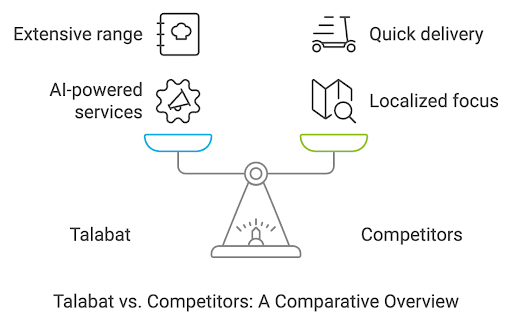
While comparing the Talabat app with its competitors, many features make it stand out. Talabat has an extensive range of restaurant options and its AI-powered services like personalized recommendations and automated customer support help enhance its user experience. This is an innovative use of technology, as it also happens to be a strong differentiator in this respect, as it means increasing the engagement with customers and organizing its operations.
Some of its competitors like Jahez, HungerStation, etc focus more on speedy delivery and a targeted approach towards the domestic market, hence it targets more differentiated customers and regional markets. However, Talabat app has taken its way differently with technology-driven services, while other competitors rely on efficiency and proximity to be fast, Talabat emphasize innovation with AI and advanced technologies.
And the Last Couse
Talabt has created a persona for itself in the Middle Eastern food delivery market with its integration of AI technology and customer-centric business model. It stands out as a platform in a competitive market because of its capacity to engage customers, optimize delivery processes, and support restaurant expansion.
The Talabat app’s advanced technology and ChatGPT’s AI abilities keep it at the forefront of the food delivery business. Talabat’s innovative business strategy and revenue-generating techniques will be crucial to maintaining its leading position as competition heats up.
FAQ
- How does the Talabat App make money?
Talabat app revenues are mainly from the incomes gained from commission pay, subscription fees, delivery fees, and advertising, among others based on data insights.
- What are the main differences between Talabat and other Saudi Arabian food delivery apps?
The main point about Talabat is that it possesses AI technology and the ChatGPT feature for customers, which brings this company closer to being more efficient and engaging with its customers.
- Does Saudi Arabia have Talabat?
With operations throughout Saudi Arabia and other nations, Talabat is one of the most well-known food delivery services in the Middle East.
- Why is Talabat’s customer engagement the best?
By utilizing AI-powered features and real-time data analytics, Talabat has increased customer engagement by 20%.
- Can you use the Talabat app for purposes other than food delivery?
Yes, Talabat offers many other services, such as grocery delivery, in addition to meal orders.