What Is an API in a Web Application?
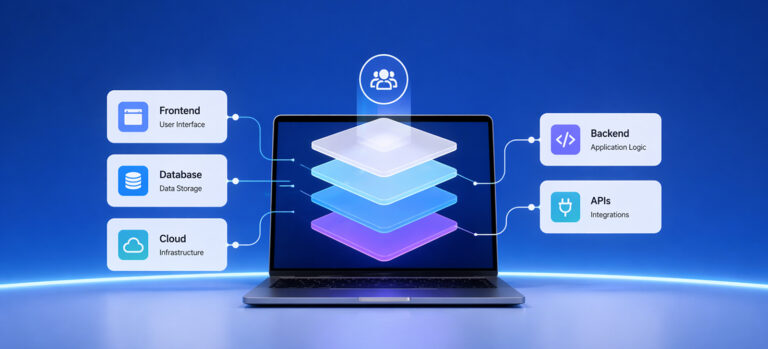
An API (application programming interface) is a defined contract that lets two pieces of software exchange data and trigger actions without sharing their internal code. In a web application, APIs work in two directions. Your application consumes external APIs — fetching live shipping rates, charging a card, sending a WhatsApp message. And it often exposes its own API so that mobile apps, partner systems or a modern JavaScript front end can use its data and logic.
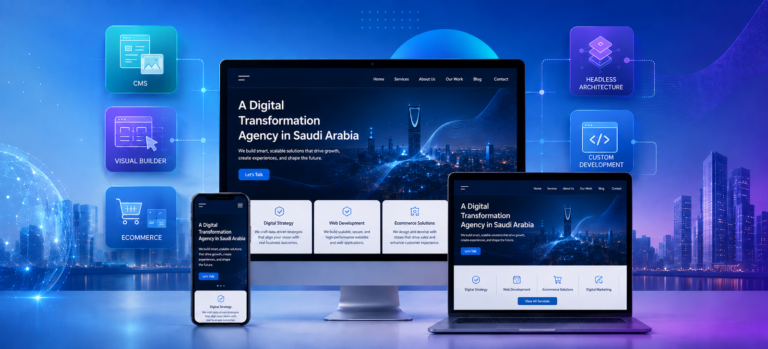
That second direction is worth pausing on, because it defines how we architect most builds in 2026: the back end (a CMS or custom service) publishes content and business logic through an API, and a fast front end — often Next.js — consumes it. This headless approach is why one content platform can feed a website, a mobile app and an in-store kiosk at once, and it is the architecture behind many of the high-performance Saudi sites we ship.
REST, GraphQL and Webhooks: Choosing the Right Style
REST — the default workhorse
REST APIs expose resources over standard HTTP verbs and JSON. They are simple, cacheable, universally understood, and remain the right default for most integrations. Nearly every service a Saudi business will connect to — payment gateways, shipping carriers, CRMs, government platforms — speaks REST first.
GraphQL — precision for complex front ends
GraphQL lets the client ask for exactly the data it needs in a single query, instead of stitching together multiple REST calls. We reach for it on content-rich, component-driven front ends — a product page that needs the product, its reviews, related items and inventory in one round trip. The trade-off is more sophisticated caching and security work on the server side, so we use it where the front-end complexity earns it, not by default.
Webhooks — let the data come to you
Webhooks invert the model: instead of your application repeatedly asking “has anything changed?”, the external service calls you when an event happens — a payment succeeds, a shipment updates, an order is placed on your Salla store. Well-designed integrations pair APIs (you pull) with webhooks (they push), which keeps systems in sync without wasteful polling.
The Integrations Saudi Businesses Actually Need
Global API guides list Stripe and Twilio and stop there. The Saudi integration map looks different, and getting it right is where local experience pays off.
Payments: Mada first, instalments close behind
Mada acceptance is the baseline for selling online in the Kingdom, and it arrives via the APIs of licensed payment gateways operating in Saudi Arabia — the integration work covers checkout flows, 3-D Secure, refunds and reconciliation. Right beside it sit the buy-now-pay-later providers, Tamara and Tabby, whose APIs add instalment options at checkout; for many Saudi retailers BNPL is now as expected as card payment. We design these as clean, swappable integration layers so a merchant can add or change providers without rebuilding the store.
Government and identity: Absher, Nafath and ZATCA
Vision 2030’s digital government programme has produced something genuinely useful for businesses: official APIs for identity and compliance. Nafath provides verified national digital identity — letting a web application confirm who a user is against government records rather than trusting a self-typed form — while the broader Absher ecosystem underpins countless citizen and business services. On the compliance side, ZATCA’s e-invoicing regime requires businesses to generate and clear invoices electronically, which in practice means invoicing flows in your web application integrating with ZATCA’s platform. These integrations involve onboarding, approvals and strict technical requirements, so we scope them as first-class workstreams, never afterthoughts.
Commerce and logistics: Salla, Zid, carriers and WhatsApp
Saudi Arabia’s homegrown commerce platforms, Salla and Zid, expose APIs and webhooks that let us sync orders and inventory with ERPs, build custom storefront experiences on top of their engines, and automate fulfilment with local carriers’ shipping and tracking APIs. Layer on the WhatsApp Business API — the channel Saudi customers actually read — for order confirmations and support, and you have the connective tissue of a modern Saudi ecommerce operation.
The operational layer: CRM, analytics, maps and AI
Beyond the local specifics, the standard integration set still applies: CRM and marketing platforms for lead flow, analytics for behaviour, mapping services for delivery zones and store locators, and — increasingly in 2026 — LLM APIs powering Arabic-capable chat assistants, search and content workflows inside web applications.
API Security and PDPL Compliance
Every API is a door into your systems, and Saudi Arabia’s Personal Data Protection Law (PDPL) has raised the stakes for leaving one unlocked. Our non-negotiables on every build: OAuth 2.0 or signed-token authentication rather than static keys where possible; secrets kept out of code and rotated; TLS everywhere; rate limiting and input validation on every exposed endpoint; webhook signature verification; and audit logging of who accessed what. Under PDPL, an API that leaks personal data is not just a technical incident but a regulatory one — so data minimisation (sending only the fields a partner actually needs) is a design principle, not a nice-to-have.
Build vs Buy: When a Custom API Is Worth It
Our rule of thumb: consume third-party APIs for commodity capabilities (payments, shipping, messaging — never rebuild these), and invest in custom APIs where your business logic is genuinely yours. A distributor’s live pricing engine, a clinic group’s booking rules, a franchise network’s reporting — these deserve well-designed internal APIs, because that is what lets a website, a mobile app and partner systems share one source of truth instead of three contradictory databases. Versioning, documentation and monitoring turn a custom API from a liability into an asset the next project builds on.
How We Approach API Integration at Element8
Two decades of integration work have settled into a simple method: map the data flows before writing code; sandbox-test every provider early (gateway and government sandboxes surface surprises weeks before launch); isolate each integration behind an internal interface so a provider change never ripples through the codebase; and monitor everything in production, because the API you depend on will have a bad day. The difference between a fragile integration and a resilient one is rarely the happy path — it is timeouts, retries, idempotency and alerting.
Frequently Asked Questions
What is a web application API?
A web application API is the interface through which a web application exchanges data with other software over the internet — either consuming external services (payments, shipping, identity) or exposing its own data and logic to front ends, mobile apps and partners. It defines the available operations, the data formats, and the authentication rules for using them.
Should I use REST or GraphQL in 2026?
Use REST as the default — it is simpler to build, cache and secure, and it is what most third-party services offer. Choose GraphQL when a complex front end needs flexible, precise queries across many related data types in single round trips. Many of our builds use both: REST for external integrations, GraphQL between our own back end and front end.
How does a Saudi website accept Mada payments?
Through the API of a licensed payment gateway operating in the Kingdom. The website integrates the gateway’s checkout or payment API, which handles Mada card processing, 3-D Secure authentication and settlement. Instalment providers like Tamara and Tabby are added the same way, via their own APIs, alongside card payment.
What is Nafath integration?
Nafath is Saudi Arabia’s national digital identity service. Integrating it lets a web application verify a user’s identity against government records — typically for onboarding, high-trust transactions or services that legally require verified identity — instead of relying on unverified sign-up forms. It requires official onboarding and compliance with the platform’s technical requirements.